

I’ve helped over sixty families plan their relocations in the last four years. And the single biggest problem — every single time — isn’t finding movers. It’s not even packing.
It’s the bill at the end.
People budget ₹12,000 for a move and get hit with ₹19,000. Not because they were cheated, but because nobody told them about stair charges, fuel surcharges, packing material costs, or what happens when a sofa won’t fit in the elevator.
That’s exactly why I put together this Packers and Movers Price Calculator — to give you a realistic estimate before you ever call a single moving company. Not a vague ballpark. A proper breakdown that includes every charge most people don’t find out about until moving day.
This guide explains how the calculator works, what drives moving costs up or down, and how to use the estimate to negotiate better with movers. By the end, you’ll know exactly what your move should cost — and what it definitely shouldn’t.
Packers and Movers Price Calculator
What Is a Packers and Movers Price Calculator?
Simply put — it’s an estimation tool that takes your specific moving details and produces a cost breakdown based on real pricing factors.
You put in:
- Move Distance (KM) — actual road distance between pickup and drop location
- Home Size — from Studio/1 BHK up to 4+ BHK
- Total Weight (KG) — approximate weight of all furniture and belongings
- Number of Floors — which floor you’re moving from (affects labor cost significantly)
- Packing Service — Yes or No
- Loading & Unloading — Yes or No
- Insurance Coverage — Yes or No
- Vehicle Transport — None, Bike, or Car
- Move Type — Local Move, Interstate, or Long Distance
- Urgent Delivery — Yes or No
And it gives you back:
- Estimated Moving Cost — the single most likely total
- Budget Range — low to high realistic range
- Distance Charges — transport and fuel cost breakdown
- Packing & Labor Charges — packing, loading, unloading combined
- Insurance & Vehicle Transport — if selected
The difference between this and calling a mover for a quote is that movers often give low estimates upfront and adjust at the end. A calculator based on actual pricing factors gives you an independent baseline — so you know what’s reasonable before anyone gives you a number.

What Actually Affects Your Moving Cost
This is the part most guides get wrong. They list factors without explaining how much each one actually matters. Let me break it down properly.
Distance — The Biggest Variable
Distance affects more than just fuel. It affects:
- Driver charges (per kilometre rates or fixed zone pricing)
- Toll expenses on highways
- Transit time, which affects labor cost on both ends
- Whether overnight stops are required for very long routes
A move from one neighbourhood to another might cost ₹3,000–₹6,000. The same household moving 800 km might cost ₹15,000–₹30,000 or more. Distance is genuinely the largest single factor.
One thing people miss: some movers charge differently for city-to-city routes versus highway routes. Always confirm which rate applies to your specific journey.
Home Size — More Rooms Means More of Everything
It’s not just about having more furniture. Larger homes mean:
- More packing materials
- More workers needed
- Larger or additional transport vehicles
- Longer loading and unloading time
Here’s a rough complexity guide:
| Home Size | Typical Complexity | Workers Usually Needed |
|---|---|---|
| Studio / 1 BHK | Low | 2–3 |
| 2 BHK | Medium | 3–4 |
| 3 BHK | High | 4–5 |
| 4+ BHK | Very High | 5+ |
A 3 BHK move doesn’t cost three times a 1 BHK move — but it often costs 1.8x to 2.2x more once labor and transport are factored in together.
Furniture Weight — Heavier Than You Think
Most families significantly underestimate how much their belongings weigh. A standard 2 BHK with moderate furniture typically runs 800–1,200 kg. Add a large wardrobe, a double-door refrigerator, and a washing machine, and you’re easily at 1,500 kg.
Weight matters because:
- Some movers charge per kilogram over a base threshold
- Heavier loads require more workers for safe loading
- Vehicle selection changes — heavier loads need larger trucks
When entering weight into the calculator, include appliances. They’re often the heaviest items and the most frequently forgotten.
Packing Services — Worth It for Some Items, Optional for Others
Professional packing is not a luxury — for certain items, it’s genuinely necessary.
Where professional packing is worth every rupee:
- LCD and OLED TVs (require foam backing and custom cartons)
- Glass dining tables and mirror frames
- Antiques or collectibles
- Fine crockery and glassware
- High-value electronics
Where you can save by packing yourself:
- Books (pack in small boxes yourself)
- Clothes and linens (use your own suitcases and bags)
- Plastic storage items
- Cushions and soft furnishings
Self-packing non-fragile items can reduce packing charges by 20–30% on a typical move. Just make sure you pack them securely — movers often won’t take responsibility for damage to self-packed boxes.
Loading, Unloading, and the Floor Factor
This is the charge that surprises people most — and your calculator captures it directly through the Number of Floors field.
Labor costs depend heavily on floor access:
- Ground floor with easy truck access: standard charge
- 2nd–3rd floor with elevator: moderate surcharge
- 4th floor or above without elevator: significant surcharge per floor
I’ve seen moves where the floor charge alone added ₹2,000–₹4,000 to a bill. If you’re moving to or from a walk-up building above the 2nd floor, this field makes a real difference to your estimate — enter it accurately.
Also consider: narrow stairwells that require furniture to be dismantled for transport. Beds, wardrobes, and large sofas sometimes can’t be moved in one piece. Dismantling and reassembly is billed separately by most movers.
Move Type — Local, Interstate, or Long Distance
Your calculator has three move type options and each one changes the pricing structure significantly:
- Local Move — same city, typically under 50 km. Labor dominates the cost.
- Interstate Move — crossing state borders. Distance, fuel, and tolls are the main drivers.
- Long Distance — 500 km or more. Transit time, overnight logistics, and carrier costs all factor in.
Select whichever matches your actual move. Getting this wrong is the fastest way to get an inaccurate estimate from the calculator.
Insurance — Small Cost, Big Protection
Moving insurance is optional. I still recommend it for any move over 200 km or any household with appliances worth more than ₹50,000.
A standard transit insurance policy adds roughly ₹800–₹2,500 to your total moving cost depending on declared value. Against the cost of replacing a damaged washing machine or refrigerator, it’s almost always worth it.
What insurance typically covers:
- Accidental damage during transit
- Fire or accident damage to the vehicle
- Theft in most policies (check the fine print)
What it usually doesn’t cover:
- Items you packed yourself improperly
- Pre-existing damage
- Extremely fragile items without professional packing
Vehicle Transport — Bikes and Cars
If you’re relocating your vehicle separately (common in long-distance moves), this is its own pricing line.
| Vehicle Type | Typical Distance-Based Cost (500 km) |
|---|---|
| Two-wheeler / Bike | ₹2,000 – ₹4,000 |
| Car (hatchback) | ₹5,000 – ₹9,000 |
| Car (sedan/SUV) | ₹7,000 – ₹14,000 |
These are ballpark numbers — actual pricing varies significantly by city, carrier availability, and whether you choose open or enclosed transport for cars.
Urgent or Express Delivery
Last-minute moves cost more. Simple reality.
When you book within 2–3 days of moving, movers often need to:
- Pull trucks from other scheduled routes
- Arrange extra labor on short notice
- Expedite packing timelines
The premium for urgent moves can be 15–30% above standard pricing. If your move date is flexible at all, booking 2–3 weeks in advance consistently produces better rates.
How to Use the Calculator — Step by Step
The tool is straightforward, but accuracy in what you enter determines how useful the estimate is.
Step 1 — Enter Move Distance (KM) Be specific. Use Google Maps to get the actual driving distance — movers charge for road kilometres, not straight-line distance. A 500 km route via highway charges differently than a 500 km route through city traffic.
Step 2 — Select Home Size Pick the option matching your current home. This sets the baseline for labor, vehicle size, and packing material estimates.
Step 3 — Enter Total Weight (KG) If you’re not sure, use this rough guide:
- 1 BHK, light furniture: 500–800 kg
- 2 BHK, moderate furniture: 900–1,400 kg
- 3 BHK, full household: 1,500–2,500 kg
- 4+ BHK or heavy appliances: 2,500 kg+
Include appliances — fridge, washing machine, AC units. They’re the heaviest items and the most frequently forgotten.
Step 4 — Enter Number of Floors This is the floor you’re moving from. Ground floor = 1. If you’re on the 3rd floor, enter 3. Higher floors without elevators significantly increase labor time and cost.
Step 5 — Select Packing Service Choose Yes if you want professional wrapping, boxing, and furniture protection. Choose No if you’re packing non-fragile items yourself to save cost.
Step 6 — Select Loading & Unloading Almost always Yes unless you have your own labor arranged. This covers the workers who physically carry items in and out.
Step 7 — Select Insurance Coverage Recommended Yes for any move over 200 km or any household with appliances worth more than ₹50,000.
Step 8 — Select Vehicle Transport None if you’re driving your vehicle yourself. Bike or Car if you need it transported separately.
Step 9 — Select Move Type Local Move, Interstate, or Long Distance. Match this to your actual situation — it changes the pricing structure significantly.
Step 10 — Select Urgent Delivery Yes only if you need same-day or next-day service. Expect a 15–30% premium on standard pricing.
A Real Example — 1 BHK Move, 500 km (Actual Calculator Result)
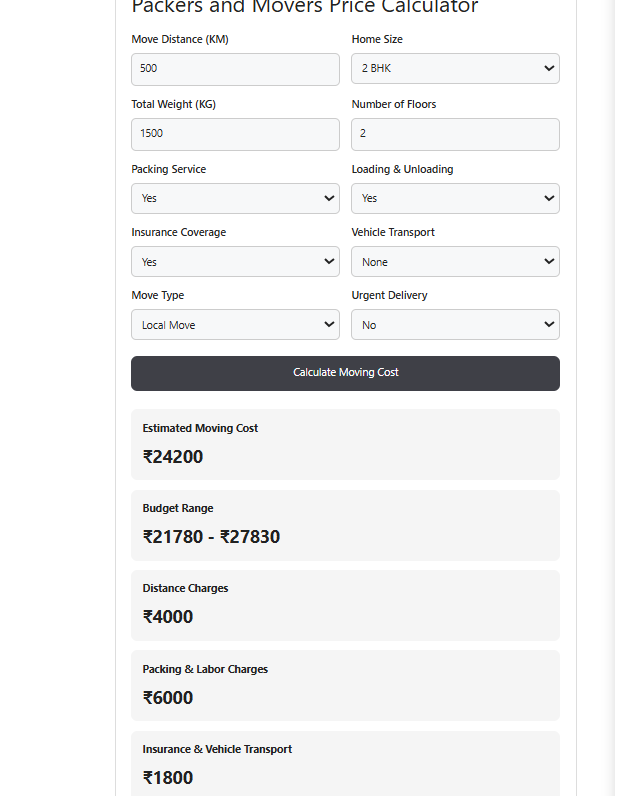
Here’s a real example using the calculator with these exact inputs:
| Calculator Field | Value Entered |
|---|---|
| Move Distance | 500 KM |
| Home Size | 1 BHK / Studio |
| Total Weight | 1,500 KG |
| Number of Floors | 2 |
| Packing Service | Yes |
| Loading & Unloading | Yes |
| Insurance Coverage | Yes |
| Vehicle Transport | None |
| Move Type | Local Move |
| Urgent Delivery | No |
What the calculator returned:
| Output | Amount |
|---|---|
| Estimated Moving Cost | ₹24,200 |
| Budget Range | ₹21,780 – ₹27,830 |
| Distance Charges | ₹4,000 |
| Packing & Labor Charges | ₹6,000 |
| Insurance & Vehicle Transport | ₹1,800 |
That budget range — ₹21,780 on the low end to ₹27,830 on the high end — is the honest picture. The low end assumes everything goes smoothly. The high end accounts for real-world variables like longer loading time, unexpected floor access issues, or additional packing material needed on the day.
The ₹24,200 estimate is your planning number. The ₹27,830 upper end is what you should have available just in case.
This is exactly the kind of breakdown you’d never get in a 30-second phone call with a mover — and it’s why running the calculator before any conversations saves you from being blindsided.
Local vs Long-Distance Moves — How Pricing Differs
The cost structure changes significantly based on move type.
| Move Type | Typical Cost Range | Main Cost Driver |
|---|---|---|
| Local (under 50 km) | ₹3,000 – ₹8,000 | Labor and vehicle size |
| City to City (50–500 km) | ₹8,000 – ₹20,000 | Distance and fuel |
| Interstate (500–1,500 km) | ₹15,000 – ₹40,000 | Distance, transit time, logistics |
| International | ₹80,000+ | Customs, freight, insurance |
For local moves, labor is often the dominant cost — more workers, more time. For long-distance moves, transportation and fuel take over as the largest line items.
How to Reduce Your Moving Costs Without Cutting Corners
These work. I’ve recommended all of them to clients who’ve used them successfully.
Declutter seriously before you start packing. Every item you don’t move is an item you don’t pay to transport. Sell furniture on OLX or Facebook Marketplace. Donate clothes you haven’t worn in a year. Moving is genuinely one of the best times to simplify your household — and it directly reduces weight, which directly reduces cost.
Get at least three quotes, not one. The first quote you get feels like the benchmark. It isn’t. Get quotes from three different movers with the same list of services and compare line by line. Price variation between movers for identical services can be 30–40%.
Book on a weekday, mid-month. Weekend moves and month-end moves (when everyone’s lease is ending) cost more because demand spikes. Tuesday through Thursday in the middle of the month consistently gets better rates. Not always possible — but when it is, it saves money.
Pack what you safely can yourself. Books, clothes, linen, soft toys, plastic items — pack these yourself in proper boxes and label them clearly. Tell the movers which boxes are self-packed. This reduces packing charges and speeds up the loading process.
Ask specifically about stair and floor charges upfront. Before signing anything, ask: “What is your stair charge per floor?” and “Do you charge extra if there’s no elevator?” Get the answer in writing. This single question has saved clients I know several thousand rupees in unexpected charges.
Mistakes That Make Moving More Expensive
Booking too late. Less than a week before your move date, your options shrink and prices rise. Plan four to six weeks ahead if possible, especially for moves during summer months or around major festivals.
Choosing the lowest quote without checking reviews. A quote ₹3,000 cheaper than competitors sometimes means damaged furniture, delayed delivery, or unexpected charges added at the destination. Check Google reviews, ask for references, and verify the company’s registration before booking.
Not inventorying your items before the movers arrive. Make a room-by-room list of every item being moved. This protects you if something goes missing and helps movers give you accurate quotes. It takes an hour and is worth every minute.
Assuming the estimate is the final price. Moving estimates — including what this calculator produces — are starting points. Final prices depend on what actually happens on moving day: how accessible your floors are, whether furniture needs dismantling, how long loading takes. Budget 10–15% above your estimate as a buffer.
Who Should Use This Calculator
Homeowners planning to relocate — get a realistic budget before you start calling movers.
Renters moving between apartments — especially useful for understanding how floor and stair charges vary between properties.
Office managers handling workplace relocation — office moves have similar cost drivers but often involve heavier equipment and more sensitive electronics. The calculator helps with initial budget planning.
Students moving to a new city — even a small studio move has real costs. Knowing the estimate helps decide whether self-transport or professional movers make more financial sense.
Families with vehicles to transport — the vehicle transport line item is easy to forget in a whole-household move. The calculator includes it so you see the real total.
Frequently Asked Questions
Is the Packers and Movers Price Calculator free to use?
Yes — completely free, no registration required. Enter your details and get an instant estimate.
How accurate is the moving cost estimate?
The calculator uses standard industry pricing factors and produces a realistic range for most moves. Actual quotes from movers may be higher or lower depending on your specific route, service provider, seasonal demand, and local conditions. Treat the estimate as a benchmark, not a guarantee.
Does moving distance really affect cost that much?
Yes — significantly. Distance affects fuel cost, driver charges, toll expenses, and whether overnight logistics are required. A 100 km move and a 700 km move for the same household can differ in cost by ₹8,000–₹15,000 or more.
Is moving insurance worth the extra cost?
For most long-distance moves and any household with appliances or electronics worth more than ₹40,000–₹50,000, yes. The premium is small relative to replacement cost. For short local moves with minimal valuables, it’s more optional.
Can I use this calculator for office shifting?
Yes. The home size and weight fields can be used to estimate office moves as well. Select the size closest to your office footprint and adjust weight to include office furniture and equipment. The estimate will give you a reasonable starting budget for office relocation.
What’s the difference between local and long-distance moving costs?
Local moves (under 50 km) are primarily costed on labor and vehicle size. Long-distance moves are primarily costed on distance, fuel, and transit time. The pricing structure is genuinely different — local moves can sometimes be cheaper to do on a weekday with fewer workers, while long-distance moves need more planning around route and timing.
How far in advance should I book movers?
Ideally three to six weeks before your move date. This gives you time to get multiple quotes, compare services, and avoid the premium pricing that comes with last-minute bookings.
Final Thoughts
Moving is stressful enough without financial surprises on the day.
The families I’ve worked with who had the smoothest relocations weren’t the ones who spent the most. They were the ones who planned ahead, understood their costs before signing anything, and went into moving day knowing exactly what they’d agreed to pay and why.
This Packers and Movers Price Calculator gives you that starting point. It won’t replace a proper quote from a verified mover — nothing does. But it gives you an independent, realistic estimate based on real pricing factors, so you walk into every conversation with movers knowing what’s reasonable and what isn’t.
Use it before you make any calls. Compare the estimate against the quotes you receive. Ask questions about any line item that’s significantly higher than the calculator’s breakdown. And add that 10–15% buffer to your actual budget — moving day has a habit of adding things nobody anticipated.
The estimate is ready. Your move is next.