
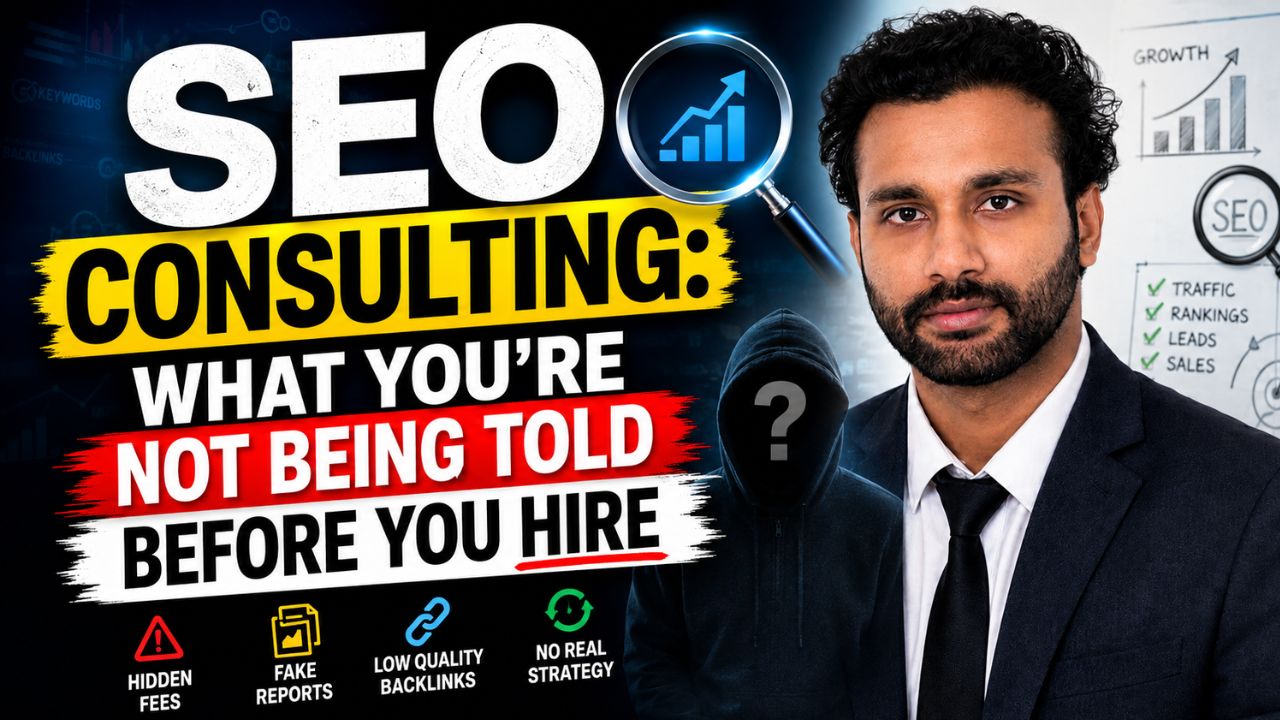
By MD Jalal Uddin | Independent SEO Consultant | 11 Years, 200+ Client Engagements May 2026 · 13 min read
I’m going to say something that most SEO consultants won’t put in writing.
A significant portion of SEO consulting engagements fail. Not because SEO doesn’t work. Not because the client didn’t follow advice. But because the wrong consultant was hired for the wrong problem at the wrong stage of a business — and neither party had an honest conversation about it before the contract was signed.
I’ve been on both sides of this. I’ve been the consultant who took on work I wasn’t the right fit for because I needed the revenue. I’ve watched competitors promise results that the timeline of SEO makes structurally impossible to guarantee. I’ve seen businesses pay serious money for audits that sat in a folder and never got implemented.
This guide is the conversation I wish happened before every SEO consulting engagement I’ve been part of — the one that would have saved clients money, saved consultants headaches, and produced better outcomes for everyone involved.
If you’re looking to hire an SEO consultant, this tells you what to look for, what to avoid, and what questions to ask before signing anything.
If you’re building an SEO consulting practice, this is the honest version of how it works — including the parts the LinkedIn thought leaders leave out.
What SEO Consulting Actually Is (And What It Isn’t)
Let me start with a definition that might surprise you.
SEO consulting is not the same as SEO services. This distinction matters more than most people realise, and conflating the two is the source of a lot of expensive misunderstandings.
SEO services means someone does the work for you. They write the content, build the links, implement the technical fixes, manage the campaigns. You pay for execution. The consultant or agency produces deliverables.
SEO consulting means someone tells you what to do and why. They diagnose problems, recommend strategies, define priorities, and advise on execution — but the actual work may be done by your internal team, another vendor, or the consultant themselves in a limited capacity.
The distinction matters because the value is different, the pricing is different, the relationship is different, and the success metrics are different.
A business with no internal marketing team and no technical resource doesn’t need a consultant. They need an agency or a full-service partner who can execute. Hiring a consultant when you have no one to implement their recommendations is like hiring an architect when you have no builders — you get beautiful plans and nothing gets built.
A business with a capable internal team that lacks strategic direction, technical SEO expertise, or visibility into why their organic traffic has stalled needs a consultant. The team can implement. What they’re missing is the strategic layer.
Know which one you need before you start talking to anyone.
The Three Types of SEO Consultants (And Which One You Actually Need)
Not all SEO consultants offer the same thing. The title covers a surprisingly wide range of expertise and approach. Here’s a framework I use to categorise them — because hiring the wrong type is one of the most common expensive mistakes businesses make.
Type 1 — The Technician
Specialises in the technical architecture of SEO. Crawlability, indexation, site speed, Core Web Vitals, structured data, log file analysis, JavaScript rendering issues, canonical implementation.
Hire this person when: Your site has traffic that should be ranking and isn’t. You’ve had an algorithmic traffic drop that doesn’t correspond to a content quality issue. You’re migrating a site and need someone to ensure organic traffic survives the transition. You’re on a platform with known SEO challenges (certain enterprise CMS systems, heavily JavaScript-rendered sites) and need someone who understands the technical realities.
Don’t hire this person when: Your problem is that you’re not producing enough content, your content isn’t good enough, or you have no links pointing to your site. Technical SEO won’t fix a content or authority problem.
Type 2 — The Content Strategist
Specialises in keyword research, search intent analysis, content architecture, topical authority building, and content optimisation. Understands how to map content to stages of the buyer journey and build the kind of organic presence that generates leads and customers, not just traffic.
Hire this person when: You’re starting an SEO content program from scratch and need direction. Your existing content isn’t ranking despite seemingly doing everything right. You want to build topical authority in a specific area and need someone to design the architecture. Your organic traffic is high but conversions are low — which usually means a content-to-intent mismatch.
Don’t hire this person when: Your technical SEO is fundamentally broken. A content strategy sitting on a site that Google can’t crawl properly is like painting a house with a cracked foundation. Fix the foundation first.
Type 3 — The Authority Builder
Specialises in link acquisition — earning, building, and occasionally buying (carefully, within Google’s guidelines) the kinds of external signals that increase a site’s authority and help it rank for competitive terms.
Hire this person when: Your content is strong and your technical SEO is clean, but you’re losing to competitors who have more authoritative backlink profiles. You’re trying to rank for genuinely competitive terms where topical authority alone isn’t enough to break through. You’ve had a manual penalty related to links and need someone to navigate the disavow and recovery process.
Don’t hire this person when: You haven’t built enough content to earn links to. There’s nothing more frustrating in SEO consulting than watching a client invest in link building to pages that have no reason to rank — weak content, poor UX, no clear value proposition for the person who lands there.
Most consultants have some competency across all three but a genuine specialisation in one or two. The honest ones will tell you where their expertise is strongest. The ones to be cautious about claim equal mastery of all three — and equal ability to execute all three simultaneously for a flat monthly retainer.
What Good SEO Consulting Looks Like in Practice
Here’s what I’ve found separates engagements that produce real outcomes from ones that produce impressive-looking reports.
It starts with a diagnosis, not a proposal
A consultant who sends you a proposal before understanding your business, your competitive landscape, your existing content, your technical setup, and your actual goals is selling you a template, not consulting.
Good consulting starts with questions. A lot of them.
- What’s your primary business model and revenue driver?
- Who is your target customer and how do they currently find you?
- What does your current organic traffic look like, and how has it changed over the past 12–24 months?
- What have you tried before in SEO, and what happened?
- What does your internal team look like — who can implement what?
- What’s your actual goal: more traffic, more leads, more revenue, recovery from a penalty, preparation for an acquisition?
The answers to these questions completely change the strategy. A business trying to recover from a Helpful Content algorithm update needs different work than a business trying to build organic presence from scratch in a competitive niche. A business with strong content and no links needs different work than a business with strong links and weak content.
Any consultant who proposes the same solution before hearing your specific situation is working from a playbook, not from diagnosis.
It separates quick wins from long-term plays
Good consulting tells you honestly which work will produce results in weeks and which work will take six to twelve months to move the needle.
SEO has both kinds of work, and the ratio matters for business planning. A business that needs revenue in ninety days should not be putting all its chips on a content strategy that takes six months to gain traction. That doesn’t mean the long-term work shouldn’t happen — it means the immediate priorities should include whatever can produce results fastest: quick-win technical fixes, optimisation of existing high-potential pages, capturing low-competition keyword opportunities.
A consultant who can’t clearly differentiate between quick-win work and long-term authority building — and articulate realistic timelines for each — either doesn’t know the difference or is avoiding the conversation because the honest timelines are uncomfortable to share.
It includes uncomfortable truths
The most valuable thing an SEO consultant can offer is an honest assessment of what’s working, what isn’t, and why.
I’ve lost potential clients by telling them their content isn’t good enough to rank and needs significant rework before more traffic will come. I’ve lost clients by telling them their product doesn’t have enough search demand to support an SEO-led growth strategy. I’ve lost clients by telling them the competitor they want to beat has a twelve-year head start in topical authority and it will take at least two to three years of consistent work to close the gap.
These conversations are uncomfortable. They’re also exactly what a business needs to hear before investing budget in a strategy that won’t deliver what they’re hoping for.
A consultant who tells you what you want to hear in the proposal stage is not doing you a favour. They’re optimising for winning the contract, not for your success.
The Red Flags That Should End Conversations Immediately
I’ve sat in enough sales calls — on both sides of the table — to know the phrases that should make you walk away.
“We guarantee first page rankings.”
No one can guarantee search rankings. Google’s algorithm is not something any consultant controls. A ranking guarantee is either dishonest or is referencing keywords so low-competition and low-value that ranking for them means nothing.
What a legitimate consultant can guarantee: their effort, their process, clear communication, and a commitment to work toward defined objectives. Outcomes in SEO involve variables neither party controls.
“We have a special relationship with Google.”
No SEO consultant has a special relationship with Google that gives them algorithmic advantage. Google doesn’t have a partner program that provides ranking benefits. Anyone claiming this is either confused or lying.
“SEO results in 30 days.”
Meaningful organic traffic growth from a standing start in thirty days is structurally impossible in almost all competitive contexts. What’s possible in thirty days: technical fixes, implementation of on-page changes, indexation improvements. What’s not possible: building topical authority, earning significant links, producing the volume of quality content needed to rank for meaningful terms.
“We don’t share our methodology — it’s proprietary.”
SEO is not a black box. The principles that drive rankings are publicly documented by Google and extensively researched by the SEO community. A consultant who won’t explain their approach is either doing something they know you’d object to, or they don’t have a coherent methodology to explain.
You should understand exactly what your consultant is doing and why. If they can’t explain it clearly, that’s a problem.
“We’ll build you 500 high-quality backlinks this month.”
Volume link building at scale is either link spam (violates Google’s guidelines), low-quality (directory submissions, forum profiles, paid links from link farms), or both. High-quality link acquisition is slow, relationship-dependent, and resource-intensive. Anyone offering hundreds of “high-quality” links per month is offering neither quality nor safety.
What to Actually Ask Before Hiring an SEO Consultant
These questions separate consultants who know their work from consultants who know how to sell their work.
“Can you show me a site you’ve worked on, explain what problem it had when you started, what you did, and what happened to organic traffic over time?”
A consultant with real results can answer this with specifics. Traffic charts. Before-and-after rankings. Context about why the results happened. Reluctance to share specifics — hiding behind NDA excuses when they have no case studies they can discuss at any level — is a meaningful warning sign.
“What would you NOT do for a business at my stage?”
This question reveals judgment. A consultant who knows what not to do — who can tell you which tactics don’t apply to your situation, which investments won’t pay off at your current level of authority, which shortcuts will create problems later — understands the work at a strategic level. Someone who can only tell you what they will do is selling services, not strategy.
“How do you handle situations where the work isn’t producing results?”
The honest answer involves regular reporting, transparent communication, willingness to diagnose and adjust, and clear criteria for evaluating whether the strategy is working. Any answer that deflects accountability — “SEO takes time” as a way to avoid specifics — should be noted.
“What does success look like at three months, six months, and twelve months?”
The milestones should be realistic and specific. Three months: technical implementation complete, content foundations in place, baseline measurements established. Six months: early ranking movement on target terms, traffic beginning to build, link acquisition underway. Twelve months: meaningful organic traffic to commercial pages, measurable impact on leads or revenue.
Generic answers like “we’ll improve your rankings” tell you nothing about whether the consultant has a plan or is improvising.
“What do you need from us to do this well?”
Good consultants have clear requirements: access to Google Search Console and Analytics, the ability to implement technical recommendations without waiting three months for developer sprints, a point of contact who can make decisions, content production capacity of some kind. A consultant who has no requirements from your team is either doing everything themselves (which limits strategic engagement) or hasn’t thought through what good implementation actually requires.
The Truth About SEO Consulting Pricing
Pricing in SEO consulting is genuinely opaque, and the opacity is not in your favour as a buyer. Here’s how to think about it.
Hourly consulting typically runs from $100 to $500+ per hour depending on experience, specialisation, and market. It’s the right model for specific, bounded engagements: audits, strategy sessions, specific technical problems. It’s harder to budget for ongoing work.
Monthly retainers for consulting (not execution) range from $1,500 to $10,000+ per month depending on scope. The right question is not “what’s a fair retainer?” but “what is being delivered for this retainer?” A $3,000 retainer that includes a monthly strategy call and written recommendations is very different from one that includes comprehensive reporting, regular content reviews, link building oversight, and on-call technical support.
Project-based pricing works well for defined deliverables: a full site audit, a keyword research and content strategy document, a site migration SEO oversight package. Scope the deliverable clearly before agreeing to a price.
What you shouldn’t do: choose based on price alone. The cheapest SEO consulting is almost never good value — either because the strategy is flawed, the expertise is thin, or the time invested is insufficient to actually move anything. The most expensive is not automatically the best either, but extreme low pricing in SEO consulting is a reliable signal of something not being said.
If You’re Building an SEO Consulting Practice
A few things I wish someone had told me earlier.
Specialise before you generalise. The consultants who command the highest rates and attract the best clients are known for something specific — ecommerce SEO, technical SEO for enterprise sites, local SEO for specific verticals, SEO for SaaS companies. Being the generalist SEO consultant is a race to the middle on pricing and a constant struggle against commoditisation. Being the best at something specific is a positioning advantage that compounds over time.
Your case studies are your marketing. Not your website. Not your social media presence. Not your thought leadership content alone. Your ability to say “here’s a business that had this problem, here’s what I did, here’s what happened” is what closes deals with serious clients. Treat every engagement as an opportunity to produce a case study. Get permission early. Document the before state carefully so the after state is meaningful.
Set client expectations before you start, in writing. The engagements that go badly almost always involve a mismatch between what the client expected and what the consultant understood they were delivering. Write it down. Timeline expectations. What you will and won’t do. What you need from the client. What success looks like and when you’d expect to see it. A well-written scope of work prevents most client relationship problems before they start.
Learn to say no to the wrong clients. Taking on clients whose business model doesn’t support an SEO investment, whose internal capacity to implement is zero, who have unrealistic timeline expectations, or whose previous experience with SEO has left them fundamentally distrustful — these engagements cost more in time and stress than they return in revenue or reputation. The ability to walk away from bad-fit clients is a business practice, not a luxury.
How to Measure Whether Your SEO Consultant Is Actually Working
This is the question clients are most reluctant to ask directly and consultants are most reluctant to answer specifically. Here are the metrics that actually tell you.
Organic sessions to commercial pages — not total organic traffic. If the only traffic growing is to your blog and your product or service pages are flat, the SEO work is producing audience but not pipeline.
Keyword ranking movement on target terms — specifically the terms connected to what you sell, not just informational terms in your general industry. Movement here shows the work is pointing in the right direction.
Backlink profile growth in quality and relevance — are new links coming from sites your customers actually read? Or are they from generic directories and unrelated blogs?
Organic conversion rate — are the people arriving from organic search doing what you want them to do? If organic traffic is growing but conversion rate is falling, the traffic being generated may not be the right traffic.
Index coverage — in Google Search Console, is the number of indexed pages growing appropriately? Are there unexplained indexation issues appearing and not being addressed?
Monthly reporting that covers these metrics honestly — including when numbers aren’t moving as expected and why — is the minimum standard for a consulting engagement worth paying for.
Frequently Asked Questions
How much does SEO consulting cost? Hourly rates for experienced SEO consultants typically range from $100 to $500+ per hour. Monthly retainers for ongoing consulting range from $1,500 to $10,000+ depending on scope, specialisation, and market. Project-based work — audits, content strategy, migration oversight — varies by deliverable. The right question is not what it costs but what it includes and what outcomes are realistic at that investment level.
How long before SEO consulting produces results? Honest answer: three to six months before meaningful traffic movement, six to twelve months before significant business impact — assuming consistent execution and a site that isn’t starting from zero authority. Quick-win technical fixes and optimisation of existing pages can produce faster movement. New content in competitive areas takes longer. Anyone promising significant results in under sixty days should be asked to explain specifically how.
What’s the difference between an SEO consultant and an SEO agency? A consultant is typically an individual (or small team) providing strategic advice, diagnosis, and direction. An agency provides a broader range of execution services — content production, link building, technical implementation — usually with a larger team. A consultant is often better for strategic problems requiring expert judgment. An agency is often better when you need execution at scale and don’t have internal resources to implement.
Can an SEO consultant guarantee rankings? No. Any consultant who guarantees specific rankings is making a promise they cannot keep — Google’s algorithm is not within anyone’s control. What a legitimate consultant can commit to is a defined process, transparent reporting, honest communication, and work consistently directed toward your agreed objectives. Outcomes in SEO involve algorithm variables, competitive variables, and implementation variables that no one controls completely.
What should an SEO consultant deliver each month? At minimum: a clear record of work completed, movement in key metrics (rankings, traffic, indexation, backlinks), an honest assessment of what’s working and what isn’t, and specific recommendations for the next period. Deliverables should be agreed at the start of the engagement so both parties have clear expectations.
How do I know if my SEO consultant is actually doing anything? Ask for access to Google Search Console and Google Analytics if you don’t already have it — you should always have direct access to your own data, not rely on consultant-produced reports. Review the metrics listed in the measurement section above monthly. Ask specifically: what was done this month, what changed as a result, and what are we doing next month and why. Vague answers to specific questions are a problem.
Final Thoughts
SEO consulting, done well, is one of the highest-leverage investments a business can make in its marketing. Organic search traffic compounds — rankings built this year produce traffic next year and the year after, without additional spend per click. A well-executed SEO strategy can shift the economics of a business’s customer acquisition in ways that paid advertising simply cannot.
But that outcome requires the right consultant for the right problem, honest expectations about timeline and investment, clear accountability on both sides, and a client who can implement what the consultant recommends.
The businesses I’ve seen get the most out of SEO consulting are not the ones who hired the most expensive consultant or the agency with the most impressive client logos. They’re the ones who understood what problem they needed to solve, found someone genuinely qualified to help with that specific problem, and committed to doing the work that the strategy required.
That starts with an honest conversation before any contract is signed.
If you’re about to hire someone for SEO consulting, ask the hard questions. Read the red flags. Know which type of consultant you actually need. And ask for the uncomfortable truths before you need them.
The right consultant will welcome those questions. That’s actually a pretty reliable signal you’re talking to the right one.
About the Author
MD Jalal Uddin has spent eleven years building organic search traffic for B2B and B2C brands — from early-stage startups finding their first thousand visitors to established businesses recovering from algorithm penalties. He believes most SEO problems are content problems in disguise, and that the brands winning in search in 2026 are the ones who figured that out before their competitors did.
Considering an SEO consulting engagement and not sure where to start? Leave your situation in the comments. I’ll give you an honest read on what you actually need.