
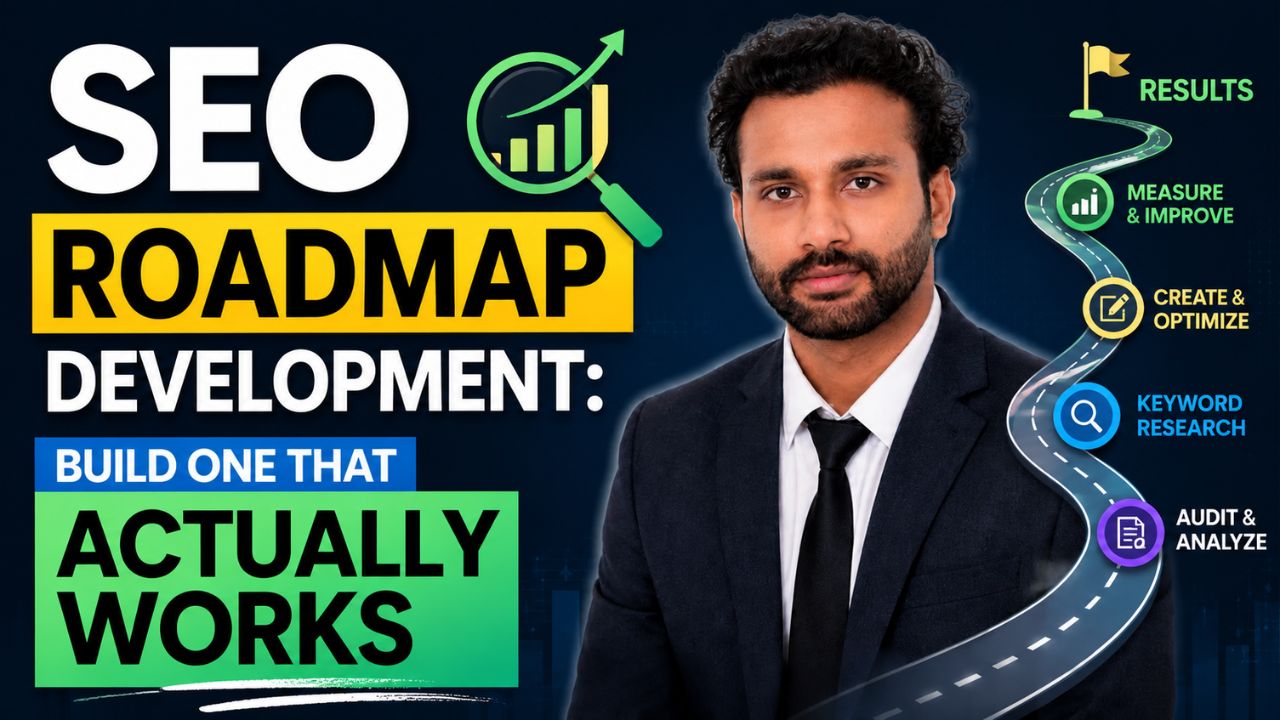
By MD Jalal Uddin | SEO Consultant & Organic Growth Strategist May 2026 · 13 min read
Every SEO engagement I’ve ever been part of started with someone asking for a roadmap.
And almost every roadmap I’ve ever seen — including ones I built early in my career — had the same fundamental problem.
They were written like instructions for assembling furniture. Step one, step two, step three. Do this, then this, then this. Completion percentage tracked in a spreadsheet. Ticked boxes celebrated as progress.
The problem is that SEO doesn’t work like furniture assembly. You don’t follow the steps and end up with a finished product. You follow the steps, measure what happened, learn something you didn’t know before you started, and adjust. Then you do it again. The roadmap that works in month one often needs to look different by month four — not because the strategy failed, but because the strategy generated information that changes what the next right move is.
A roadmap written as a fixed sequence of tasks is not an SEO roadmap. It’s a project plan. And project plans are the wrong tool for a discipline that is fundamentally iterative, competitive, and dependent on variables you can’t fully control before you start.
This guide is about building an SEO roadmap the right way — one that gives your team direction without creating false certainty, that prioritises correctly without becoming rigid, and that evolves as the work generates real data about what’s actually working.
Why Most SEO Roadmaps Fail Before They Start
Let me describe the most common SEO roadmap I see when I audit a client’s previous work.
Month 1: Technical audit and fixes. Month 2: Keyword research and content planning. Month 3–6: Content production. Month 7–12: Link building.
Neat. Sequential. Logical. And almost entirely wrong as a framework for how SEO actually produces results.
Here’s what the sequential model misses.
Technical fixes and content aren’t sequential — they’re parallel. A site with significant technical problems can still publish content. Some content will rank despite technical issues. Some technical fixes will have no perceptible ranking impact because content is the actual problem. Treating technical SEO as something that must be “completed” before content work begins wastes months and delays results unnecessarily.
Keyword research done in month two is stale by month six. Search behaviour shifts. Competitors enter or exit terms. Google updates change which types of content rank for which queries. Keyword research is not a one-time deliverable. It’s an ongoing process of understanding what your audience is actually searching for right now — which changes.
Link building without something worth linking to is wasted effort. Starting link acquisition in month seven — after content production is “complete” — misses the opportunity to build links to content as it’s being produced, when the pages are fresh and the relevance of outreach is highest. It also assumes content production is ever really “complete,” which it isn’t.
The model ignores competitive response. Your competitors are not sitting still while you execute a twelve-month plan. They’re publishing content. They’re building links. They’re optimising their pages. An SEO roadmap that doesn’t include competitive monitoring and response is a plan to fight a static enemy that doesn’t exist.
The sequential model feels structured and professional. It is also how organisations produce a year of SEO activity with modest results and then conclude that SEO “doesn’t work for their business.”
What an SEO Roadmap Actually Needs to Do
Before I describe how to build one, let me establish what a good SEO roadmap is actually for.
It needs to communicate priority, not sequence. The most important question in SEO roadmap development is not “what do we do first?” It’s “what has the most impact on our specific situation right now?” Those are different questions with different answers depending on your site’s current state, your competitive landscape, and your business goals.
It needs to build in review and adjustment. A roadmap without planned review points is a set of assumptions locked in place. Build in explicit moments — monthly, quarterly — where you assess what the data is showing and adjust accordingly. These aren’t signs of a failing plan. They’re the mechanism by which a plan stays relevant.
It needs to translate SEO work into business outcomes. “Publish twelve blog posts” is not an SEO objective. “Generate 500 monthly organic sessions to commercial pages within six months” is. A roadmap that can’t be connected to business outcomes — leads, revenue, trial signups, whatever your conversion event is — cannot be defended to stakeholders who control budget. More importantly, it can’t be evaluated as successful or unsuccessful.
It needs to be honest about uncertainty. SEO roadmaps that promise specific outcomes at specific times create expectations that SEO’s inherent variability cannot reliably meet. A roadmap that says “we expect to begin seeing ranking movement on target terms by month three, with meaningful traffic impact by month six, acknowledging that competitive and algorithmic factors may affect timing” is harder to sell and more honest to deliver against.
The Four-Layer SEO Roadmap Framework
Here is the framework I use when building SEO roadmaps for clients. It’s not organised by month or by task type. It’s organised by layer — because each layer of SEO work is always in progress simultaneously, at different intensities at different stages.
Layer 1 — Foundation (Technical SEO)
This is the floor. Not a starting phase that gets completed — a floor that must be maintained and occasionally repaired as the site grows and changes.
What goes in Layer 1:
Initial audit priorities (Month 1–2):
- Crawlability: can Google access and index your important pages?
- Core Web Vitals: are your pages passing performance thresholds?
- Indexation: are the right pages indexed and the right pages excluded?
- Site architecture: can Google understand the hierarchy and relationship between your pages?
- Mobile usability: are there technical issues affecting mobile experience?
Ongoing maintenance (Month 3 onwards):
- Monthly crawl to catch new technical issues
- Regular Google Search Console review for coverage errors and manual actions
- Site speed monitoring as new content and functionality is added
- Structured data implementation as content types develop
The roadmap mistake in this layer: Treating the technical audit as a one-time deliverable. Technical SEO is not done when the initial fixes are implemented. Sites grow, break, and accumulate issues over time. The roadmap should include ongoing technical monitoring as a permanent layer, not a completed phase.
Layer 2 — Content Architecture
This is where most of the strategic leverage in SEO lives — and where most roadmaps are either too vague or too rigid.
What goes in Layer 2:
Topical core definition (Month 1): Before any keyword research, define the narrowest topical area where your site has genuine expertise and business relevance. This is not your industry. It’s your specific angle within it. A B2B SaaS company selling project management software to construction firms doesn’t own “project management.” They own a very specific problem space within a very specific industry. That specificity is what makes topical authority buildable.
Keyword and intent mapping (Month 1–2, ongoing quarterly): Map every question, concern, comparison, and problem your target audience has within your topical core. Categorise by intent — informational (learning), navigational (finding), commercial (comparing), transactional (buying). Assign business priority to each category. Not all search intent is equally valuable to your specific business.
Content architecture design (Month 2): Design your pillar and cluster structure before writing anything. A pillar page covering your core topic comprehensively. Cluster pages going deep on each subtopic. Supporting content for comparison, FAQ, and tool-based searches. This architecture needs to exist as a plan — with URLs, titles, target keywords, and internal linking relationships mapped — before production begins.
Content production calendar (Month 2 onwards): Produce content in cluster order, not random topic order. Completing a cluster builds topical authority faster than publishing one page from each of several clusters simultaneously. Prioritise clusters closest to your conversion funnel first — the content that exists to bring in people who are closest to buying.
The roadmap mistake in this layer: Treating keyword research as a deliverable rather than an ongoing process. The keyword list you build in month two will be incomplete by month six. Build in quarterly keyword research reviews specifically to find new opportunities opened by ranking progress and to identify new terms emerging in your niche.
Layer 3 — Authority Building
Links. The most misunderstood and most mismanaged layer of SEO.
What goes in Layer 3:
Competitive backlink analysis (Month 1–2): Before building any links, understand the link gap between your site and the sites ranking for your target terms. How many links do they have? From which types of sites? What content attracted those links? This analysis defines the scale of the authority challenge and informs which link acquisition methods are most appropriate for your situation.
Link acquisition strategy (Month 2–3, ongoing): There is no single right approach to link building. The right approach depends on your industry, your content, your resources, and your current authority level. Some options:
- Digital PR and data-led content: Publishing original research, surveys, or data that journalists and bloggers in your industry will cite. High impact, resource-intensive, irregular cadence.
- Content-led outreach: Identifying resource pages, roundups, and articles that link to competitors but not to you, and reaching out with a reason to include your content. Requires strong content to outreach to.
- Broken link building: Finding broken links on relevant sites and offering your content as a replacement. Time-intensive but highly targeted.
- HARO and journalist queries: Responding to journalist requests for expert sources. Builds links from high-authority media sites at no cost beyond time.
- Strategic partnerships and co-marketing: Building relationships with complementary businesses that produce natural linking opportunities through collaboration.
Link monitoring (Ongoing): Track new links acquired. Track lost links (pages that previously linked to you and no longer do). Monitor your competitors’ new link acquisitions — who is linking to them and why tells you where new opportunities exist.
The roadmap mistake in this layer: Starting link building too early — before there is content worth linking to — or starting too late, treating it as a phase that begins after content is “done.” Authority building should begin as soon as there is meaningful content on the site, even at low intensity, and continue in parallel with content production throughout the roadmap.
Layer 4 — Measurement and Iteration
This is the layer most roadmaps skip entirely, treating measurement as a reporting function rather than a strategic function.
What goes in Layer 4:
Baseline measurement (Month 1): Before any work begins, document your current state across every metric that matters. Current rankings for target terms. Current organic sessions to commercial pages. Current organic conversion rate. Current backlink profile. Current Core Web Vitals scores. Current indexation numbers.
Without a baseline, you cannot measure progress. Without measurable progress, you cannot defend the investment or make evidence-based adjustments to the strategy.
Monthly review (Every month): Review movement across key metrics. Which terms have moved? Which pages have gained traffic? Which link acquisition efforts produced results? What does Google Search Console show about crawl and indexation changes?
The output of the monthly review is not a report — it’s a decision. What do we continue, what do we adjust, what do we stop?
Quarterly strategy review (Every three months): Step back from monthly execution and assess whether the strategic direction is correct. Are we targeting the right topics? Is our content cluster architecture generating the topical authority signals we expected? Are our target terms the right terms — or has competitive or algorithmic change shifted the opportunity landscape?
This is where the roadmap updates. Not as a sign of failure, but as a sign that the work is generating real information and the strategy is responding to it.
Attribution and business impact (Quarterly): Connect organic traffic movement to business outcomes. Which organic sessions are converting? At what rate? What revenue or pipeline can be attributed to organic? This is the conversation that keeps SEO investment justified at the leadership level — and the conversation most SEO roadmaps are not structured to support.
How to Prioritise When Everything Feels Urgent
This is the practical question that roadmap frameworks often fail to answer directly. Here is how I actually make prioritisation decisions.
The Impact-Effort matrix, applied to SEO:
I categorise every potential SEO action across two dimensions:
Impact: How much will this move rankings, traffic, or conversions if we do it well?
Effort: How much time, resource, and technical complexity does this require?
The resulting four quadrants:
| Low Effort | High Effort | |
|---|---|---|
| High Impact | Do first, immediately | Plan carefully, commit properly |
| Low Impact | Do if you have capacity | Question whether to do at all |
In practice, the “do first, immediately” quadrant in early-stage SEO typically contains:
- Fixing crawl errors that are blocking important pages
- Adding missing title tags and meta descriptions to commercial pages
- Fixing broken internal links on high-traffic pages
- Optimising existing pages that rank on page two (positions 11–20) for target terms
- Implementing basic structured data on key page types
These actions require relatively little resource and can produce meaningful ranking movement quickly — because they’re fixing problems that are actively holding rankings back.
The “plan carefully, commit properly” quadrant contains content cluster development, digital PR campaigns, and comprehensive technical migrations. These require sustained investment to produce results, but the results are durable.
The “question whether to do at all” quadrant contains a surprising number of things that appear in generic SEO checklists — social media signals, certain directory submissions, elaborate internal linking schemes for sites with thin content. Question everything in this quadrant before committing resource to it.
The SEO Roadmap Template I Actually Use
Here is the structure of the roadmap document I produce for clients. Not as a rigid template — but as a framework that ensures the right questions get answered before work begins.
Section 1 — Situation Assessment
- Current organic performance (baseline metrics)
- Technical SEO status (critical issues, moderate issues, minor issues)
- Content audit (what exists, what ranks, what has potential, what should be retired)
- Backlink profile (current authority, link gap to target competitors)
- Competitive landscape (who ranks for target terms and why)
Section 2 — Strategic Objectives
- Primary business goal (leads, revenue, signups, brand awareness)
- Topical core definition
- Target audience and intent mapping
- Success metrics at 3 months, 6 months, 12 months
Section 3 — Priority Actions by Layer
- Foundation: critical technical fixes (prioritised by impact)
- Content: cluster architecture and production priorities
- Authority: link acquisition approach and targets
- Measurement: tracking setup, reporting cadence, review schedule
Section 4 — Resource Requirements
- Who does what (consultant, internal team, additional vendors)
- Content production capacity needed
- Technical implementation access required
- Budget allocation by layer
Section 5 — Review Schedule
- Monthly review agenda and metrics
- Quarterly strategy review criteria
- Conditions that would trigger a strategy adjustment
This document is living. Section 5 is what makes it living — the explicit commitment to revisit, reassess, and adjust based on what the work reveals.
The Honest Timeline Conversation
Every SEO roadmap needs an honest timeline section that sounds something like this.
Month 1–2: Foundation work. Technical issues identified and prioritised. Keyword and intent mapping complete. Content architecture designed. Measurement infrastructure in place. Early quick-win content improvements deployed.
Month 2–4: First content cluster in production. Early link acquisition beginning. Technical improvements being implemented. First ranking movements on low-competition target terms expected.
Month 4–6: First content cluster approaching completion. Topical authority signals beginning to build. Ranking movement on mid-competition terms beginning. Link profile growing modestly. First attribution of organic leads or revenue to specific content.
Month 6–12: Second and third content clusters in development. More competitive terms beginning to move. Link acquisition producing cumulative authority impact. Organic traffic becoming a measurable and growing channel.
Month 12+: Compounding returns from established topical authority. Rankings on competitive terms. Organic becoming a predictable, scalable acquisition channel.
This timeline assumes consistent execution, competent implementation, and no major algorithmic disruptions. It also assumes a site starting with some existing authority — a completely new domain with no history takes longer.
Share this timeline honestly with stakeholders before any work begins. Misaligned expectations are the most common reason SEO engagements end prematurely — not because the strategy is wrong, but because the people holding the budget expected outcomes on a timeline that SEO cannot structurally deliver.
Common SEO Roadmap Mistakes and How to Avoid Them
Building the roadmap before completing the audit. You cannot prioritise correctly without understanding your current state. An audit is not a deliverable that happens after the roadmap — it’s the input that makes the roadmap possible. Build the roadmap from audit findings, not from a generic template.
Including too many priorities. A roadmap with twenty priorities has no priorities. It has a list. Force ranking of every item on the roadmap by impact. The top five actions at any given time should be clear enough that any team member could name them without looking at the document.
No owner for each action. Every item on the roadmap needs a named owner and a realistic timeline for completion. Collective ownership means no ownership. “The team will produce content” is not an action item. “Sarah will publish the pillar page on [topic] by [date]” is.
Treating the roadmap as finished. The roadmap is not a document you produce and then execute against unchanged for twelve months. It’s a strategic framework that evolves as the work generates information. Build in explicit revision points and resist the temptation to treat deviation from the original plan as failure.
Optimising for activity over outcomes. A roadmap that measures success by how many tasks were completed is optimising for the wrong thing. Pages published is activity. Organic sessions to commercial pages is an outcome. Links built is activity. Domain authority improvement is an outcome. Measure outcomes. Let activity be the means, not the measure.
Frequently Asked Questions
What is an SEO roadmap? An SEO roadmap is a strategic document that defines priorities, timelines, and responsibilities for improving a website’s organic search performance. Unlike a simple task list, a good SEO roadmap is organised by strategic layer — technical foundation, content architecture, authority building, and measurement — and includes explicit review points to adjust strategy based on results. It translates SEO work into expected business outcomes and sets honest expectations about timeline.
How long does it take to develop an SEO roadmap? A thorough SEO roadmap takes two to four weeks to develop properly — including a technical audit, competitive analysis, keyword and intent mapping, content audit of existing assets, and backlink profile review. Roadmaps produced faster than this are typically built from assumptions rather than data. The time invested upfront in a thorough situation assessment produces significantly better prioritisation than starting from a generic template.
What should an SEO roadmap include? A complete SEO roadmap should include: a baseline situation assessment, strategic objectives connected to business outcomes, priority actions across technical SEO, content, and authority building layers, resource requirements and ownership, realistic timelines with honest uncertainty acknowledged, measurement setup and reporting cadence, and a scheduled review process. Any roadmap missing the review process is a project plan, not a strategic roadmap.
How often should an SEO roadmap be updated? Monthly reviews should assess metric movement and make tactical adjustments. Quarterly reviews should step back and assess whether the strategic direction remains correct. Annual reviews should reassess the full situation — competitive landscape, topical core, business objectives — and produce an updated roadmap for the next period. The roadmap should be a living document, not a fixed plan.
How do I prioritise items on an SEO roadmap? Use an impact-effort framework. Identify which actions have the highest potential impact on your specific situation (not generic impact — impact for your site, at your current authority level, in your competitive context) and require the least resource to implement. Do those first. Then plan carefully for high-impact, high-effort initiatives. Question anything low-impact before committing resource to it, regardless of how often it appears in generic SEO checklists.
What is the difference between an SEO roadmap and an SEO strategy? An SEO strategy defines the overall approach — who you’re targeting, what topical area you’re building authority in, what content architecture you’re using, how you’ll build links, how you’ll measure success. An SEO roadmap translates that strategy into specific actions, priorities, timelines, and owners. Strategy answers “what are we trying to do and why?” The roadmap answers “specifically what are we doing, in what order, by when, and who is responsible?”
Final Thoughts
An SEO roadmap built correctly is one of the most valuable documents a marketing team can have. It aligns stakeholders on realistic expectations. It gives practitioners clear priorities. It connects daily SEO work to business outcomes. And it gives everyone involved a framework for making good decisions as the work generates new information.
An SEO roadmap built incorrectly — as a fixed sequence of tasks, built from a template rather than a diagnosis, with no review mechanism and no connection to business outcomes — creates the appearance of strategic SEO work while producing the outcomes of random SEO activity.
The difference between the two is not technical expertise. It’s intellectual honesty about how SEO actually works, what it can and cannot guarantee, and how a strategy needs to evolve as it encounters reality.
Build the roadmap from your audit findings. Organise it by layer, not by month. Build in review points before you start. Set honest timeline expectations before stakeholders have committed to outcomes you can’t deliver. And treat the roadmap as the living document it needs to be — not the finished plan you produce once and execute unchanged.
That’s SEO roadmap development done right. Everything else is a spreadsheet with a timeline.
About the Author
MD Jalal Uddin has been developing SEO roadmaps for businesses ranging from early-stage startups to established brands for over a decade. He has built roadmaps that worked, roadmaps that needed significant adjustment after month three, and a few early in his career that he’d build completely differently today. He writes about the gap between how SEO is typically presented and how it actually works in practice — because that gap is where most SEO budget gets wasted.
Building an SEO roadmap and not sure where to start — or inheriting one that isn’t working? Leave the situation in the comments. Happy to give you an honest read on what might be missing.