
Three out of every four people who add something to a cart never buy it.
That’s not a rounding error. That’s the reality of ecommerce. Baymard Institute puts the average cart abandonment rate at 70.19% — meaning the majority of your potential customers are already sold on your product, they went to the trouble of adding it to their cart, and then they left.
The good news is that a well-built abandoned cart email sequence gets a significant portion of them back. Not all of them. But enough to make a measurable difference to your revenue — without spending another dollar on advertising.
I’ve set up abandoned cart sequences for brands ranging from small Shopify stores to mid-sized DTC operations. Some sequences worked immediately. Some needed fixing. A few worked so well that recovering cart revenue became a meaningful percentage of total monthly sales.
This guide covers exactly what I’ve learned: the right number of emails, the right timing, the right angle for each one, and the mistakes that quietly kill conversion rates.
Why People Abandon Carts — and Why It Matters for Your Emails
Before writing a single email, you need to understand why people leave. Because the reason someone abandoned their cart determines what your email needs to say to bring them back.
The most common reasons, according to Baymard’s research:
- Extra costs were too high (shipping, taxes, fees) — 48%
- Had to create an account — 26%
- Didn’t trust the site with card info — 25%
- Delivery too slow — 23%
- Just browsing, not ready to buy — 19%
- Payment process too complicated — 18%
Look at that list carefully. Most of those reasons are not “I changed my mind about the product.” They’re friction points — logistics concerns, trust issues, unexpected costs, timing.
That changes what your emails need to do.
Your abandoned cart sequence isn’t just a reminder. It’s an objection-handling sequence. Each email should address a specific reason someone might have left — and give them a genuine reason to come back and complete the purchase.
How Many Emails Should Be in the Sequence?
The short answer: three.
One email is not enough. A lot of people genuinely just got distracted — a phone call, a meeting, dinner. One email catches some of them but misses the ones who need a gentle nudge the next day, or the ones who needed time to think.
Five or six emails is too many and damages your relationship with people who were never going to buy anyway. Nothing accelerates unsubscribes like being hammered with cart reminders.
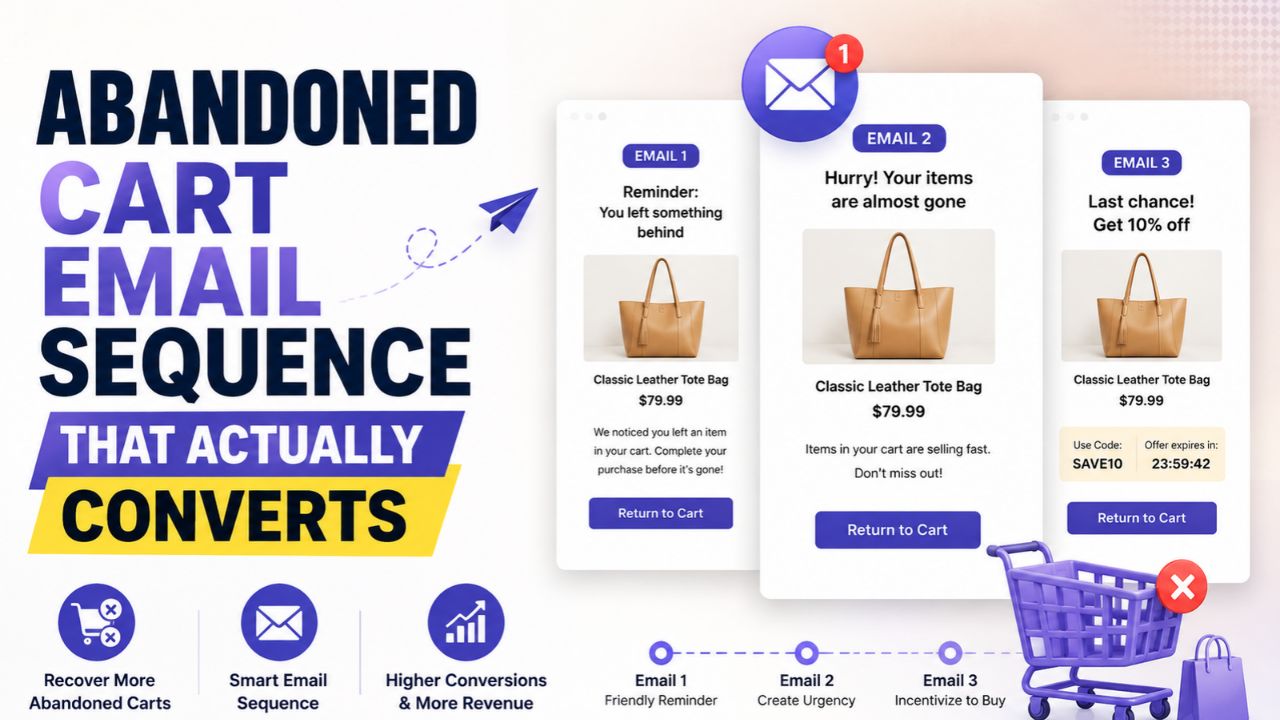
Three emails, spaced correctly, hits the sweet spot for most ecommerce stores. Here’s the structure I come back to consistently:
| Timing | Primary Goal | |
|---|---|---|
| Email 1 | 1 hour after abandonment | Catch distracted shoppers |
| Email 2 | 24 hours after abandonment | Handle objections |
| Email 3 | 72 hours after abandonment | Create urgency or offer incentive |
Let me walk through each one in detail — because the timing is only half of it. What you say in each email matters just as much.
Email 1 — The “Did You Forget Something?” Email (Send at 1 Hour)
Why one hour?
Because the people who abandon out of distraction are most recoverable in the first hour or two. They added the item. They were ready. Something pulled them away. An email in their inbox while they’re still thinking about it — or at least while it’s still fresh — has the best chance of bringing them back immediately.
Wait 24 hours for your first email and you’ve missed the easiest conversions.
The goal of Email 1:
Simple. Remind them what they left. Make it frictionless to come back.
This email doesn’t need to be clever. It doesn’t need to offer a discount. It doesn’t need to do heavy lifting. It just needs to show them what they left and put the cart one click away.
What to include:
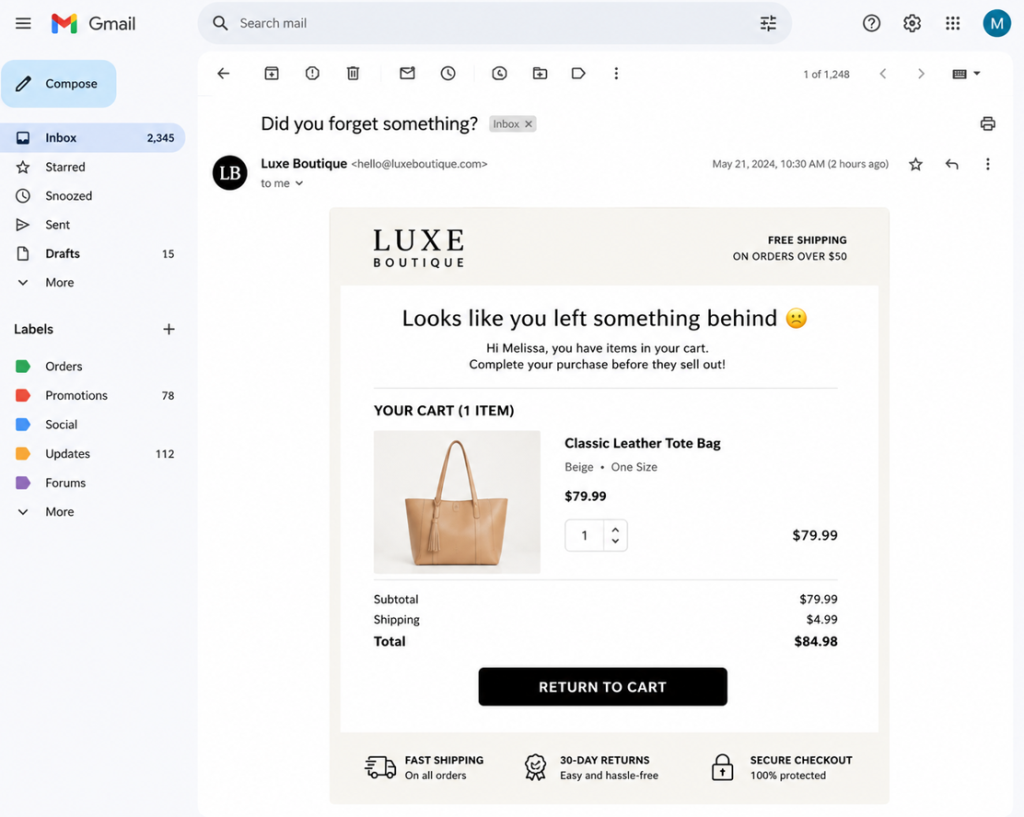
- Product image (large, clear, the actual item they added)
- Product name and variant (size, color — the exact one they chose)
- Price
- A single, obvious CTA button back to their cart
- Your return/exchange policy in one line (removes purchase risk)
Subject line options that work:
- “You left something behind”
- “Still thinking it over? Your cart is saved.”
- “Your [product name] is waiting”
- “[First name], you forgot something”
What NOT to do in Email 1:
Don’t offer a discount. Not yet. A meaningful portion of people will come back for free — and if you train your customers to expect a discount in every cart abandonment sequence, they’ll start abandoning carts intentionally to wait for the offer. That’s a real pattern that happens with sequences that discount too early.
Email 1 copy angle:
Helpful, not pushy. Assume the best — they got busy, they got distracted, life happened. You’re just making it easy to come back.
Email 2 — The Objection Handler (Send at 24 Hours)
If someone didn’t come back after Email 1, they didn’t just forget. There’s a reason they haven’t returned. Email 2’s job is to address the most likely objections head-on.
The goal of Email 2:
Build confidence and remove friction. Address the reasons people don’t buy even when they want to.
This is where your email needs to do actual work. Not just remind — convince.
What to include:
Social proof. Show reviews for the specific product they left. Not generic reviews — if you can pull in reviews for the exact product, the exact variant, that’s significantly more persuasive. Three to five genuine reviews with specific details outperform a star rating every time.
Trust signals. Secure checkout badge, money-back guarantee, return policy. Make them visible and explicit. Don’t assume people know your policy — say it clearly.
Shipping clarity. If shipping was possibly a concern (and for 48% of abandoners it was), address it directly. “Free shipping on orders over $X” or “Ships in 2–3 business days” removes a real objection.
Answer the obvious question. What’s the one thing someone sitting on the fence about your product would want to know? Address it. Is it sizing? Include a size guide link. Is it material? Say it. Is it “will this actually work?” Include a before/after or a specific result from a review.
Subject line options:
- “Is something holding you back?”
- “Here’s what other customers said about [product name]”
- “Free shipping + 30-day returns — just so you know”
- “Real reviews from real customers”
Email 2 copy angle:
Informative and reassuring. You’re not chasing — you’re answering questions they probably have but didn’t ask. The tone is confident, not desperate.
Email 3 — The Closer (Send at 72 Hours)
By now, three days have passed. The people who were going to come back easily have already come back. Email 3 is for the fence-sitters — people who genuinely want the product but haven’t pulled the trigger yet.
This email needs a reason to act now rather than later. Two approaches work consistently:
Approach A — Scarcity (if real)
If the item is genuinely low in stock, say so. “Only 3 left in stock” is one of the most effective conversion triggers in ecommerce — but only if it’s true. Fake scarcity is detectable, damages trust, and increasingly violates platform policies in some regions.
If you can pull live inventory data into your email, do it. “Only 2 left in your size” is better than “limited stock remaining.”
Approach B — Incentive (if appropriate)
A small discount or free shipping offer — only if your margins support it and only in the final email of the sequence.
10% off or free shipping tends to outperform larger discounts. You’re not trying to make the product half-price — you’re removing the last bit of friction for someone who already wants it.
Subject line options:
- “Last chance — your cart expires soon”
- “Only 3 left — just so you know”
- “Here’s 10% off, because you came this close”
- “[First name], this is our last reminder”
What to include:
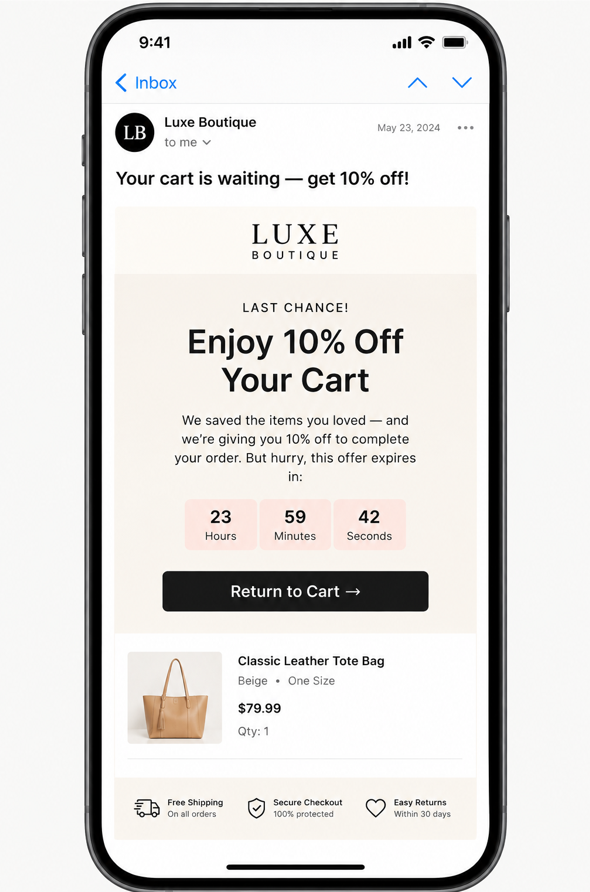
- The product (image, name, variant)
- The incentive or scarcity notice — prominently
- A clear expiry (“Offer expires in 24 hours”)
- One strong CTA
Email 3 copy angle:
Honest urgency. Whether it’s real scarcity or a time-limited offer, be clear about what it is and when it ends. Then stop. Don’t send a fourth email unless you’re running a specific reengagement campaign weeks later.
Subject Lines — What Actually Gets Opened
The most converting email in the world doesn’t recover a cart if nobody opens it. Here’s what I’ve seen work across sequences:
Personalization works — up to a point. First name in the subject line (“Rachel, you left something behind”) improves open rates but is now common enough that the lift is smaller than it was five years ago. Still worth doing, especially in Email 1.
Curiosity works better than clever. “You left something behind” outperforms “We noticed you browsed our store 👀” in most tests. Direct beats clever for abandoned cart emails because the reader already knows what it’s about — you’re not trying to surprise them.
Emoji use is category-dependent. Fashion and lifestyle brands see a lift with relevant emoji. B2B and higher-price-point products don’t. Test it for your specific audience rather than assuming either way.
Best performing subject line formulas by email:
Email 1 (reminder tone):
- “[Product name] is waiting in your cart”
- “Don’t forget — [product name]”
- “Your cart is saved. Pick up where you left off.”
Email 2 (social proof/trust tone):
- “What customers are saying about [product name]”
- “Before you decide — read this”
- “Your questions, answered”
Email 3 (urgency/incentive tone):
- “This is expiring: [X]% off your cart”
- “Only [X] left — your cart is still saved”
- “Final reminder — and a little something extra”
The Mistakes That Kill Abandoned Cart Sequences
I’ve audited a lot of these sequences. The same mistakes come up repeatedly.
Sending Email 1 too late. If your first email goes out 6–12 hours after abandonment, you’ve missed the distracted shoppers. The one-hour window is not arbitrary — it’s when recovery rates are measurably higher.
Using the same angle for every email. Sending three “here’s your cart” reminders is not a sequence. Each email needs a different job: remind, convince, close. If they all look the same, the second and third emails feel like spam.
Discounting in Email 1. You’re training customers to abandon carts to wait for discounts. Don’t do it. Reserve any incentive for the final email only.
Generic product images. A blurry image or a placeholder graphic in the product section of your email destroys credibility. The product image in your cart email should be the same high-quality image from your product page — ideally the hero image.
No mobile optimization. More than 60% of emails are opened on mobile. If your abandoned cart email requires horizontal scrolling or has a CTA button too small to tap, you’re losing mobile recoveries regardless of how good the copy is.
Forgetting to suppress buyers. If someone completes the purchase after Email 1, they must be removed from the sequence before Email 2 sends. Sending a cart reminder to someone who already bought is one of the fastest ways to annoy a new customer. Set up purchase suppression before you launch any sequence.
Timing Deep Dive — Why These Windows Work
The 1-hour, 24-hour, 72-hour cadence isn’t random. Here’s the logic behind it.
1 hour — catches impulsive abandoners, people pulled away by distraction, and people who left because checkout felt like too much commitment right in that moment. They’re still warm. The purchase intent is still high.
24 hours — catches considerers. People who wanted to think about it overnight, compare options, check if they could afford it this month. By 24 hours, they’ve had time to think. Your email arrives as a thoughtful follow-up, not a chase.
72 hours — the outer edge of purchase intent for most impulse-adjacent products. Beyond three days, cart recovery rates drop significantly. If someone hasn’t bought after three days and two follow-ups, they either changed their mind or found it elsewhere. One final email with urgency or incentive is worth sending. After that, let it go.
What a High-Converting Abandoned Cart Email Looks Like
Structure matters as much as copy. Here’s the anatomy of an email that performs:
Above the fold (visible without scrolling):
- Brand logo
- Short, direct subject-line-matching headline (“You left something behind”)
- Product image — large, clear
- Product name and price
Middle section:
- Trust signal (returns policy, security badge, or shipping info)
- Social proof (1–3 reviews for that specific product)
- Brief copy — 2–3 sentences maximum
Bottom section:
- Single CTA button — large, obvious, one action only
- Secondary text link as backup (“Or view your full cart here”)
What to leave out:
- Navigation menu (keeps focus on conversion)
- Multiple CTAs competing for attention
- Long paragraphs
- Anything not directly related to completing the purchase
The email should feel like a helpful nudge, not a sales page. One focus. One action. Everything else removed.
Measuring Whether Your Sequence Is Working
Three numbers tell you what you need to know:
Open rate — industry average for abandoned cart emails is around 40–45%, significantly higher than standard promotional email. If you’re below 30%, your subject lines need work.
Click rate — 8–10% is a reasonable benchmark. If people are opening but not clicking, the email content or CTA isn’t doing its job. Usually a product image or CTA button problem.
Recovery rate — the percentage of abandoned carts that convert into purchases. This varies widely by industry, price point, and audience. A 5–10% recovery rate on abandoned carts is considered solid. Some sequences do better. The number itself matters less than whether it’s improving over time.
Check these weekly for the first month after launch. The sequence will tell you what it needs — whether that’s better subject lines, a stronger Email 2, or an adjusted incentive in Email 3.
Quick Setup Checklist Before You Launch
Before your sequence goes live, confirm these:
- ✅ Purchase suppression is active (buyers exit the sequence automatically)
- ✅ Unsubscribe link is present and functional in every email
- ✅ Product images are pulling dynamically from your catalog
- ✅ Cart URL is personalized and returns the customer’s exact cart
- ✅ Emails are mobile-optimized and tested on actual devices
- ✅ All three emails have been previewed in at least two email clients
- ✅ Timing triggers are set correctly (1hr, 24hr, 72hr from abandonment)
- ✅ Email 3 discount code (if used) has a working expiry
Missing any one of these will reduce your recovery rate. The checklist takes ten minutes to run through. Do it before you flip the sequence live.
Frequently Asked Questions
How many emails should an abandoned cart sequence have? Three is the standard recommendation for most ecommerce stores. One email recovers the easiest conversions but misses fence-sitters. Three emails — spaced at 1 hour, 24 hours, and 72 hours — catches distracted shoppers, handles objections, and closes with urgency or incentive. More than three emails has diminishing returns and increases unsubscribe rates.
When should I send the first abandoned cart email? Within one hour of abandonment. This is when purchase intent is still highest and distracted shoppers are most recoverable. First emails sent after 6–12 hours see meaningfully lower open and click rates than those sent within the first hour.
Should I offer a discount in my abandoned cart emails? Not in Email 1 or Email 2. Reserve any discount or free shipping offer for the final email only. Offering a discount in the first email trains customers to abandon carts intentionally to wait for an offer. If you’re going to use a discount, make it time-limited and put it in Email 3 only.
What subject line works best for abandoned cart emails? Direct, personal subject lines outperform clever or vague ones for most stores. “You left something behind,” “Your cart is saved,” and “[Product name] is waiting” consistently perform well for Email 1. Social proof angles (“Here’s what customers are saying”) work well for Email 2. Urgency and incentive subject lines (“Last chance — 10% off your cart”) perform best for Email 3.
How do I stop sending cart emails to people who already bought? Set up purchase suppression in your email platform before launching the sequence. This automatically removes anyone who completes a purchase from receiving subsequent cart abandonment emails. In Klaviyo, Mailchimp, Drip, and most major platforms, this is a standard flow trigger setting. Not setting this up results in sending cart reminders to customers who just bought — a reliable way to annoy new customers.
What’s a good cart recovery rate? A 5–10% recovery rate on abandoned carts is a solid benchmark for most ecommerce stores. Some stores with strong brand affinity and well-optimized sequences see higher. The more useful metric is whether your rate is improving — that tells you whether your sequence is actually working and where to optimize.
Final Thoughts
Cart abandonment is not a failure. It’s an opportunity that most stores are leaving on the table.
The math is straightforward: if 70% of people who add to cart don’t buy, and a well-built sequence recovers even 8% of those abandoners, you’ve just added meaningful revenue without touching your ad budget. For stores doing significant cart volume, that adds up to real money every month.
The sequence I’ve outlined — Email 1 at one hour, Email 2 at 24 hours, Email 3 at 72 hours — is not complicated. The copy angles are not secret. The subject lines are not magic. What makes a sequence work is doing all of it correctly, consistently, and then measuring what the data tells you to improve.
Set it up once. Check it monthly. Optimize what the numbers show you. Let it run.
The carts are already being abandoned. The sequence is what decides whether that revenue comes back.