

By MD Jalal Uddin | SEO Campaign Strategist | 11 Years Running Organic Search Programmes May 2026 · 13 min read
The word “campaign” is doing a lot of damage in SEO.
It comes from advertising. In paid media, a campaign has a start date, an end date, a fixed budget, and a defined objective. You run it, measure it, report on it, and move on. The campaign is a unit of work with a clear beginning and end.
When businesses bring that mental model into SEO, things go wrong in a very specific way.
They allocate budget for a six-month SEO campaign. The campaign runs. Some rankings improve. Traffic ticks up. The campaign ends — because campaigns end — and the budget moves to something else. Three months later, the rankings they earned have softened. The traffic gains have partially reversed. The business concludes that SEO produces temporary results and isn’t worth sustained investment.
What they experienced wasn’t a failure of SEO. It was a failure of the campaign model applied to a discipline that doesn’t work like a campaign.
SEO is not a campaign. It’s a compounding asset. The difference between those two things determines almost every strategic decision you’ll make — how to structure the work, how to measure it, how to resource it, and how to explain it to stakeholders who keep asking why results take so long.
But — and this is the productive tension I want to work through in this guide — campaigns can exist within SEO. Done correctly, a campaign-within-a-strategy structure is one of the most powerful ways to organise SEO work. The mistake is not running campaigns. The mistake is treating the entire SEO programme as a campaign.
This guide is about the distinction. How to build campaign-level focus into an SEO strategy without importing the paid media mental model that makes campaigns fail.
What Happens When You Treat SEO Like a Campaign
Let me walk through the anatomy of a failed SEO campaign — because the pattern is consistent enough that it’s worth naming clearly.
Month 1–2: Agency or consultant onboarded. Audit completed. Keywords researched. Content calendar created. Everything feels organised and purposeful.
Month 3–4: Content production underway. Some technical fixes implemented. First pieces published. Rankings haven’t moved yet — it’s early, everyone agrees.
Month 5–6: Some ranking movement on lower-competition terms. Traffic ticks up modestly. A few pieces are performing. The team feels optimistic.
Month 6: Campaign budget reviewed. Results are “promising but early.” Decision made to continue, reduce, or pause depending on budget pressure.
Month 7–9 (if continued at reduced investment): Content production slows. Link building deprioritised. The algorithm continues to evolve. Competitors who didn’t pause continue publishing and building authority.
Month 12: Rankings on terms that started moving have either held (if continued) or softened (if paused). Traffic is roughly where it was or modestly above. The business asks whether SEO is worth the continued investment.
The core problem in this sequence is not execution. The content might have been good. The technical fixes might have been correct. The links might have been legitimate and relevant.
The problem is structural. SEO authority compounds over time — each piece of content, each link, each technical improvement builds on what came before. Stopping that compounding process at month six is like stopping compound interest halfway through — you lose not just the future gains but some of what you’d already built.
The campaign model imports a start-and-stop rhythm into a discipline that rewards continuity above almost everything else.
The Right Mental Model: SEO as Infrastructure, Campaigns as Accelerators
Here is the reframe that makes everything else work.
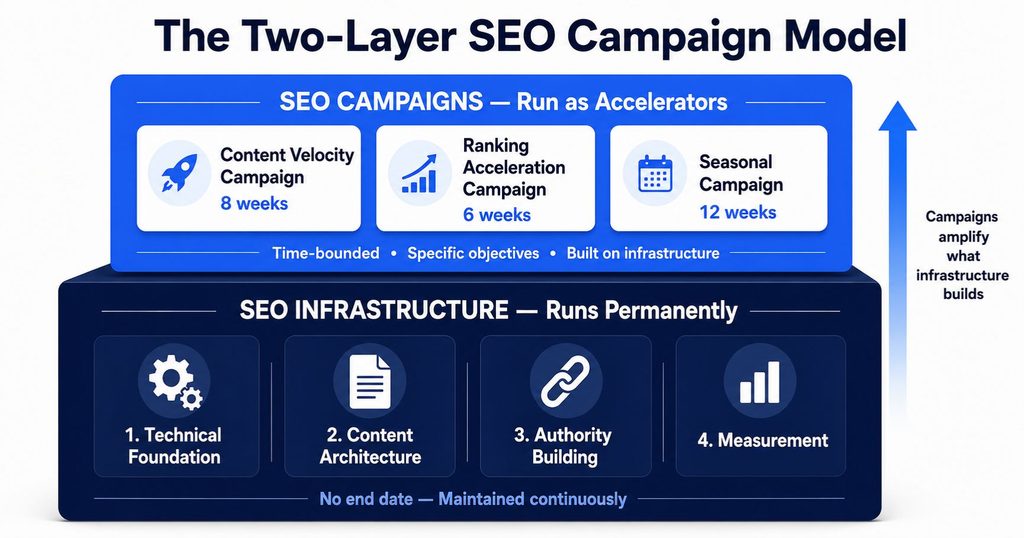
SEO is infrastructure. Like a building’s foundation, it takes time to lay correctly, needs maintenance to remain sound, and becomes more valuable over time as more is built on top of it. You don’t complete infrastructure and move on. You maintain it, expand it, and build from it.
SEO campaigns are accelerators. They are focused, time-bounded bursts of activity designed to capture a specific opportunity, push into a new topical area, or produce a measurable outcome within a defined window. They run within the infrastructure, not instead of it.
This distinction changes how you plan, resource, and measure SEO work.
The infrastructure runs continuously — a permanent programme of content production, technical maintenance, link acquisition, and measurement. It doesn’t have an end date. It has a budget that gets reviewed and adjusted based on performance, like any other core business function.
Campaigns run on top of the infrastructure — three-month sprints targeting a specific product launch, a seasonal opportunity, a competitive gap, or a new topical area. They have defined objectives, timelines, and success criteria. They begin and end. The infrastructure continues.
A business that builds both — sustained infrastructure plus targeted campaigns within it — compounds authority continuously while still capturing time-sensitive opportunities. That’s the structure I want to walk you through in this guide.
Building the SEO Infrastructure Layer
Before any campaign makes sense, the infrastructure needs to exist. Here’s what that means in practice.
Permanent Technical Foundation
Technical SEO is not a project. It’s a maintenance function.
A site that passed a technical audit in January will have new issues by April — new pages published without proper canonicalisation, page speed degraded by a new plugin, structured data broken by a template update, crawl errors accumulating from a site reorganisation.
The infrastructure layer includes a recurring technical audit cadence — monthly crawl review, quarterly comprehensive audit, immediate response to Google Search Console alerts. This runs regardless of what campaigns are active. It is the floor that everything else stands on.
What the technical infrastructure layer covers permanently:
- Core Web Vitals monitoring and maintenance
- Crawl error identification and resolution
- Index coverage health in Google Search Console
- Structured data implementation and maintenance
- Internal linking health — broken links, orphaned pages, thin linking to commercial pages
- Mobile usability monitoring
- Site speed tracking as new content and functionality is added
Permanent Content Architecture
The content infrastructure is not a content calendar. It’s a topical coverage map — a defined architecture of what topics the site will cover, at what depth, organised in clusters that build topical authority systematically.
This architecture defines:
- The topical core (the narrowest area of genuine expertise)
- The pillar and cluster structure
- The priority order for cluster development
- The internal linking relationships between content pieces
- The content types needed at each stage of the buyer journey
The content architecture doesn’t change with every campaign. It’s the long-term map that campaigns navigate within. A campaign might accelerate development of a specific cluster, or add a new sub-topic to the architecture — but the architecture itself is the persistent strategic layer.
Permanent Authority Building
Link acquisition is not something you do for six months and stop. Authority builds cumulatively. A site with a strong link acquisition programme running consistently for three years has a fundamentally different competitive position than a site that ran a link-building campaign once and moved on.
The infrastructure includes an ongoing, low-intensity link acquisition programme that runs continuously:
- Regular outreach to relevant sites in the topical area
- Ongoing HARO and journalist query responses for expert source mentions
- Relationship maintenance with sites that have linked before
- Monitoring and reclamation of brand mentions that haven’t linked
The intensity varies — campaigns add resources and focus, the infrastructure maintains baseline activity between campaigns.
Permanent Measurement and Reporting
Measurement is infrastructure. Not campaign-specific. The tracking setup, reporting cadence, and attribution model need to be in place before any meaningful evaluation of results is possible — and they need to remain consistent over time to produce the trend data that makes good decisions possible.
Infrastructure measurement includes:
- Google Analytics 4 with conversion events properly configured
- Google Search Console connected and monitored
- Rank tracking for target terms
- Backlink monitoring for profile growth and lost links
- Monthly reporting to a consistent template so trends are visible
Building a Campaign Within the Infrastructure
With infrastructure in place, campaigns become what they should be — focused accelerators toward specific objectives. Here’s how to build one correctly.
Step 1 — Define the Campaign Objective Precisely
A campaign objective in SEO is not “improve our rankings.” It’s not “increase organic traffic.” These are directions, not objectives.
A real campaign objective is specific enough that you can answer yes or no to whether it was achieved:
- “Rank in the top five for [specific term] within 90 days”
- “Generate 200 organic leads from [specific content cluster] within six months”
- “Achieve 10,000 monthly organic sessions to [product category] pages by Q4”
- “Establish topical authority in [new subject area] sufficient to rank for [tier of terms] within four months”
The specificity is not arbitrary. It determines what success looks like, what resources the campaign needs, and how long it should run. A vague objective produces a vague campaign that’s impossible to evaluate.
Step 2 — Identify the Specific Opportunity the Campaign Is Targeting
Every good SEO campaign is built around a specific opportunity — a gap that exists right now, in the competitive landscape, that can be captured with focused effort.
Types of campaign-worthy opportunities:
The Uncontested Cluster A topical area where your target audience has clear search demand and no strong competitor has built comprehensive coverage. These opportunities close over time — once a competitor identifies them, they’re no longer uncontested. A campaign can capture them before that happens.
The Seasonal Window Some search demand is seasonal — it peaks at predictable times and drops outside those windows. A campaign structured to build authority and ranking before the seasonal peak — not during it, because SEO takes time — can capture disproportionate traffic at peak demand. Content published three months before a seasonal peak has time to rank. Content published during the peak doesn’t.
The Competitor Vulnerability When a competitor loses rankings — due to an algorithm update, a site migration gone wrong, or a penalty — there’s a window to capture the audience they were serving. This window is typically short. A campaign that identifies and moves quickly can capture traffic and authority before the competitor recovers or another site fills the gap.
The Product or Category Launch When a business launches a new product, service, or category, organic search is often an afterthought. A campaign built around a launch — establishing topical authority in the new category before the launch date — produces organic visibility from day one rather than starting the SEO clock at launch.
The Ranking Acceleration Target Existing content sitting in positions 11–30 for valuable terms is an immediate campaign opportunity. These pages have demonstrated relevance — Google just hasn’t decided they’re good enough to rank higher. A focused campaign of content improvement, link building to those specific pages, and internal linking restructuring can move them into position 1–10, sometimes quickly.
Step 3 — Define the Campaign Resource Requirements
Once the objective and opportunity are clear, resource requirements follow directly.
A campaign targeting an uncontested cluster needs content production resources — writers who can produce comprehensive, high-quality content at pace — and link acquisition resources to build authority to the new cluster pages.
A campaign targeting seasonal demand needs content production completed early enough to build authority before the seasonal window, which means starting three to four months before peak.
A campaign targeting ranking acceleration for existing content needs technical improvement resources, link building to specific pages, and content optimisation capability.
Define explicitly:
- How many pieces of content, and at what depth?
- How many links, to which pages, from what types of sites?
- What technical work needs to accompany the content and link activity?
- Who produces each element and by when?
Resource requirements without this level of specificity produce campaigns where everyone is busy and nothing decisive happens.
Step 4 — Set Campaign Duration Based on the Opportunity, Not the Budget Cycle
This is where campaign thinking most commonly goes wrong.
Campaign duration should be determined by what the objective requires — not by when the quarterly budget review happens or when the agency contract term ends.
Some objectives are achievable in sixty days — a ranking acceleration campaign on existing content with strong link support can move pages significantly in sixty days. Some objectives require six months — building topical authority in a new cluster from scratch takes time regardless of how much resource is applied.
The honest conversation about duration is one that most businesses avoid because the answers are sometimes uncomfortable. “This campaign will need at least six months of consistent execution before we expect meaningful movement” is not a satisfying answer when the CFO wants to know ROI by Q2.
Have that conversation anyway. A campaign with an artificially shortened timeline produces a partial outcome, gets evaluated as a failure, and creates the false conclusion that the approach doesn’t work — when the real problem was insufficient duration.
Step 5 — Build Campaign-Specific Measurement
In addition to the infrastructure measurement layer, each campaign needs its own success metrics — the specific numbers that tell you whether this campaign achieved its objective.
Campaign metrics sit on top of infrastructure metrics. They’re more specific and more time-bounded.
Example campaign measurement for a topical authority campaign:
| Metric | Baseline | 30-Day Target | 60-Day Target | 90-Day Target |
|---|---|---|---|---|
| Pages indexed in target cluster | 0 | 8 | 16 | 24 |
| Average position for cluster terms | N/A | 30–50 | 20–40 | 10–25 |
| Organic sessions to cluster pages | 0 | 200 | 600 | 1,500 |
| Links to cluster pages | 0 | 5 | 15 | 30 |
| Organic leads from cluster | 0 | 2 | 8 | 20 |
These targets are illustrative — actual numbers depend on the specific opportunity, the site’s authority, and the resources applied. The structure is what matters: specific metrics, specific targets, specific time windows, tracked from a defined baseline.
The Campaign Types That Produce the Best Results
After building and evaluating dozens of SEO campaigns across different industries and business models, here are the campaign types I come back to most because their return on investment is consistently high.
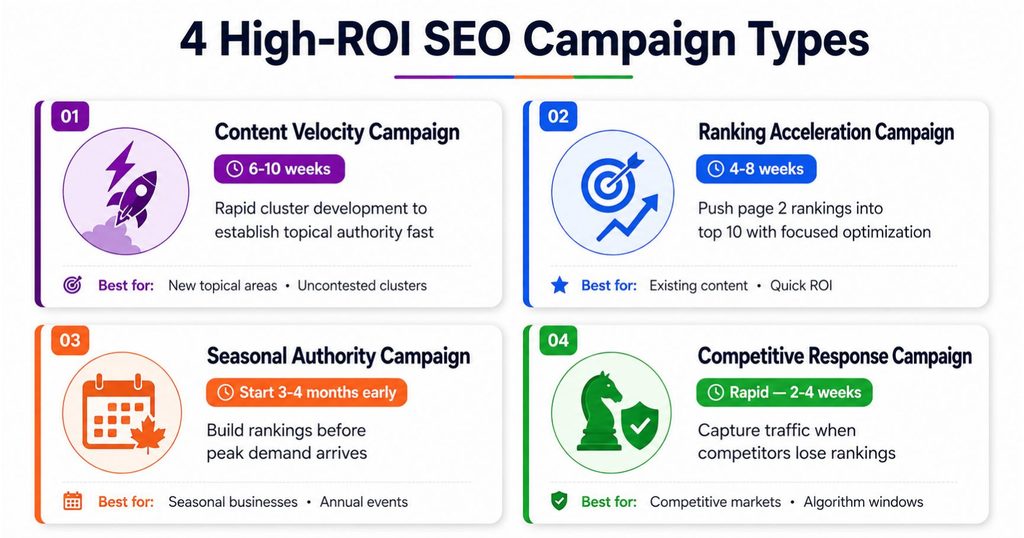
The Content Velocity Campaign
What it is: A concentrated burst of content production in a specific cluster, designed to establish topical authority faster than a steady-state content programme would allow.
Why it works: Google’s topical authority signals respond to the depth and breadth of coverage within a subject area. Publishing fifteen cluster pages over six months produces slower authority building than publishing the same fifteen pages over eight weeks — because the cluster reads as more complete, more quickly, to both Google and the humans linking to it.
How to run it: Define the cluster. Design all pages in the cluster before production begins. Produce them in quick succession — one week between publications, maximum. Internally link each new page to all previous cluster pages and the pillar. Promote each piece to relevant audiences to generate early links and signals.
Best for: Entering a new topical area, establishing authority before a competitive entrant does, or capturing an uncontested cluster before it becomes contested.
The Ranking Acceleration Campaign
What it is: A focused effort to push existing pages from positions 11–30 into the top ten for high-value terms.
Why it works: Pages in positions 11–30 have already passed Google’s relevance threshold. Something is holding them back — content quality, authority to the specific page, internal linking, or a combination. Identifying and fixing that something produces ranking movement faster than building new pages targeting the same terms.
How to run it: Audit all pages in positions 11–30 for target terms. For each, identify the most likely cause of underperformance — content depth, link profile, page experience, internal linking. Build a specific improvement plan for the highest-value pages. Execute improvements and build links to target pages specifically. Monitor weekly.
Best for: Sites with existing content that ranks poorly, businesses wanting faster results than a new content programme can deliver, quick ROI demonstration on existing SEO investment.
The Seasonal Authority Campaign
What it is: Content and authority building timed to establish ranking before seasonal demand peaks.
Why it works: Most businesses publish seasonal content during the season. By then, it’s too late for new content to rank in time. Publishing three to four months before peak — while building links specifically to those pages — produces authority before demand peaks, capturing traffic at the moment it’s highest.
How to run it: Identify the seasonal terms most relevant to the business. Map when search demand peaks using Google Trends or keyword tool data. Work backwards — if peak demand is in November, campaign starts in July or August. Publish content, build links, internally link prominently. By the time demand peaks, the content has had months to accumulate authority.
Best for: Ecommerce businesses with seasonal products, any business with predictable seasonal demand patterns, content businesses that cover annual events or recurring industry moments.
The Competitive Response Campaign
What it is: A rapid-response campaign to capture search demand when a competitor loses rankings.
Why it works: When a competitor drops rankings significantly — due to algorithm impact, penalty, or site issues — their audience doesn’t disappear. They search again, looking for the same information or solution, and land on whoever ranks next. That next-ranking site captures audience that was previously unavailable.
How to run it: Monitor competitor rankings for significant drops using tracking tools. When a drop is identified, quickly assess which terms are now available and which of your pages could capture them with rapid improvement or link building. Execute the improvement rapidly — competitive windows close as competitors recover or others move in.
Best for: Competitive markets where major players are vulnerable, businesses willing to monitor competitor rankings actively, teams capable of rapid execution.
Measuring SEO Campaign Success Honestly
Here is a measurement framework that applies to any SEO campaign, regardless of type.
Before the campaign: Establish baselines Document the current state of every metric the campaign will affect. Position for target terms. Organic sessions to target pages. Organic conversions from target pages. Backlinks to target pages. Number of pages in target cluster. Without baselines, movement is invisible.
During the campaign: Track leading indicators Leading indicators move before results do. Pages published, links acquired, technical improvements implemented, internal links added — these are activities that predict future ranking movement. Track them weekly to ensure execution is on pace.
After the campaign: Measure lagging indicators Lagging indicators reflect actual results. Ranking positions, organic sessions, organic conversions, organic revenue attributed to campaign pages. These move more slowly than leading indicators — allow at least four to six weeks after campaign completion before evaluating lagging metrics, as SEO results accumulate with a lag.
On an ongoing basis: Track compounding effects The value of an SEO campaign doesn’t stop when the campaign ends. A cluster built in a six-month campaign continues to rank and generate traffic for years — if the infrastructure layer maintains and builds on it. Track the ongoing revenue contribution of completed campaign assets as part of the case for continued SEO investment.
The Stakeholder Conversation Nobody Wants to Have
Every SEO campaign strategy needs to include an honest stakeholder conversation — about timeline, about uncertainty, about what the campaign can and cannot guarantee.
Here is the version of that conversation I have before every engagement:
“This campaign is designed to produce [specific outcome] within [specific timeline]. We believe this is achievable based on [the competitive landscape analysis / the authority gap assessment / the specific opportunity identified].
What we cannot guarantee is the exact timing of ranking movement — Google’s algorithm contains variables neither we nor anyone else can control. What we can guarantee is consistent, quality execution of everything within our control.
Here’s how we’ll know by [date] whether we’re on track: [specific leading indicators at that point]. If we’re off track at that point, here’s what we’ll assess and potentially adjust: [specific diagnostic criteria].
The risk of this campaign not producing results comes from: [honest assessment of execution risks, competitive risks, algorithmic risks]. Here’s how we’re mitigating each.”
This conversation is uncomfortable. Clients want certainty. Stakeholders want guarantees. The honest answer to “will this campaign rank us number one?” is “we don’t know — here’s what we’re doing to make it as likely as possible and here’s how we’ll know if it’s working.”
Businesses that have this conversation before the campaign starts make better decisions throughout. Businesses that avoid it end up in difficult conversations at month six about why the guarantee wasn’t delivered.
Common SEO Campaign Strategy Mistakes
Starting the campaign before the infrastructure is ready. A campaign running on a site with significant technical issues, no conversion tracking, and no content architecture is a campaign building on sand. Fix the foundation before running campaigns on top of it.
Choosing campaign objectives based on what’s impressive rather than what’s achievable. “Rank number one for [extremely competitive term] within ninety days” is not a campaign objective. It’s an aspiration disconnected from reality. Campaign objectives should be ambitious and achievable — not one or the other.
Running campaigns in isolation from the infrastructure. A content velocity campaign that produces fifteen pieces of content with no internal linking to existing pages, no link acquisition, and no measurement infrastructure is a collection of pages, not a campaign. Every campaign element needs to connect to the infrastructure layer.
Evaluating campaign success too early. Measuring organic traffic impact four weeks after a content campaign ends is measuring before the results have had time to materialise. Allow at minimum eight to twelve weeks after campaign completion before evaluating lagging indicators.
Not documenting what the campaign produced. At the end of every campaign, document what was built — the pages created, the links acquired, the technical improvements made, the rankings achieved. This documentation is the foundation for the next campaign and the evidence base for continued SEO investment.
Frequently Asked Questions
What is an SEO campaign strategy? An SEO campaign strategy is a focused, time-bounded plan to achieve a specific organic search objective — within a sustained SEO infrastructure. It differs from an overall SEO strategy in that it has a defined start, defined success criteria, and a defined timeline. Effective SEO campaign strategy treats the campaign as an accelerator within a long-term programme, not as a replacement for one.
How long should an SEO campaign last? Campaign duration should be determined by what the objective requires, not by budget cycles. A ranking acceleration campaign targeting existing content can produce meaningful results in sixty to ninety days. A topical authority campaign building a new content cluster typically requires four to six months. A seasonal campaign needs to begin three to four months before peak demand to give content time to rank. Define the objective first, then set the duration.
What makes an SEO campaign fail? The most common causes of SEO campaign failure are: treating the campaign as the entire SEO programme rather than an accelerator within one; setting objectives that are not achievable within the campaign timeline; stopping execution before results have had time to materialise; measuring results too early; and failing to maintain the infrastructure that campaign results depend on after the campaign ends.
How do I measure SEO campaign success? Establish baselines before the campaign begins for every metric the campaign affects — rankings, organic sessions, organic conversions, backlinks. Track leading indicators weekly during the campaign — content published, links acquired, technical improvements made. Measure lagging indicators eight to twelve weeks after campaign completion — ranking positions, traffic, conversions, revenue. Track ongoing compounding effects of campaign assets over the following twelve months.
Can I run multiple SEO campaigns simultaneously? Yes, with resource caveats. Multiple campaigns targeting different clusters or objectives can run in parallel if resources are sufficient to execute each properly. The risk of running too many simultaneous campaigns is that each is under-resourced and none achieves its objective. Better to run two campaigns well than four campaigns poorly.
How is an SEO campaign different from a paid advertising campaign? A paid advertising campaign stops producing results when it ends — the moment you stop spending, the traffic stops. An SEO campaign produces compounding results that continue after the campaign ends — content published during a campaign continues to rank and generate traffic for years with minimal ongoing investment. This makes SEO campaigns a fundamentally different investment with a different return profile: slower initial return, but durable and cumulative.
Final Thoughts
The campaign model isn’t wrong for SEO. Running focused, time-bounded sprints toward specific objectives is a genuinely effective way to organise SEO work — more effective, often, than a diffuse “do a bit of everything all the time” approach.
What’s wrong is running campaigns without infrastructure, or treating a campaign as the complete answer to an SEO need that requires sustained investment.
The businesses that get the best results from SEO campaigns are the ones that treat them correctly — as accelerators within a compounding programme, targeted at specific opportunities, built with honest objectives and honest timelines, measured with patience and specificity, and connected to an infrastructure layer that maintains and builds on what the campaign produces.
The word “campaign” doesn’t have to damage SEO. Used correctly — with clear eyes about what it means and what it doesn’t — it’s one of the most useful organising concepts in a well-run SEO programme.
But it has to be used correctly. The paid media mental model — start date, end date, fixed budget, move on — is the version that fails. The accelerator-within-infrastructure mental model is the version that works.
That’s the distinction. Everything else in SEO campaign strategy follows from getting it right.
About the Author
MD Jalal Uddin has been building SEO campaigns within long-term organic growth programmes for over a decade — across ecommerce, SaaS, media, and professional services. He has watched the campaign mental model succeed and fail often enough to understand exactly where the line is. He writes about the difference between SEO that looks productive and SEO that actually is — because that difference is rarely where people expect to find it.
Running an SEO campaign that isn’t producing the results you expected? Drop the situation in the comments. The diagnosis usually starts in the same place.